
You’re about to spend a half-million dollars (or more) buying an HVAC business. The trucks depreciate. The tools wear out. The building lease renews or it doesn’t. But the eight technicians who show up every morning and generate $3 million in revenue? They’re irreplaceable — and everyone in the industry knows it except most buyers.
You’ve probably been looking at HVAC businesses for sale and comparing SDE multiples, fleet condition, customer concentration, and equipment age. All the standard stuff. Smart. Keep doing that.
But I’m going to tell you about the single most important factor that almost never appears as a line item in the valuation: whether the company you’re buying actually has enough human beings to run its trucks.
I sold my company in 2022. Three years earlier, I’d been running twelve trucks with a full crew and grossing $4.2M. By the time I sold, I was running nine trucks because I couldn’t find three techs to fill the seats. My revenue dropped to $3.4M. Not because I lost customers — because I physically couldn’t get to them fast enough.
The buyer who took over my company didn’t buy a twelve-truck operation. He bought a nine-truck operation with three expensive paperweights in the parking lot. And honestly? If I’d had all twelve seats filled, I’d have asked for $300K more. And gotten it.
The Most Expensive Thing You’re Buying Isn’t Equipment — It’s People
Here’s the state of the HVAC labor market in 2026, and it’s not getting better anytime soon.
- 110,000+ unfilled HVAC technician positions nationwide, according to the BLS and industry association estimates
- 480,000 total skilled trade vacancies across HVAC, plumbing, and electrical — the broader ecosystem is starving for people
- Retirement-to-replacement ratio: 5:2. For every five experienced techs who retire, roughly two new ones enter the field. The pipeline isn’t just slow — it’s structurally broken.
- The average age of an HVAC technician in the U.S. is 45. The average retirement age in the trades is 61. Do the math on when the next wave of retirements hits.
What does this mean if you’re buying a company?
The workforce is no longer just an operational input — something you “manage” after closing. It’s the primary value driver. A company with a full, stable crew in 2026 is a fundamentally different asset than the same company in 2019, when you could post a job on Indeed and have four qualified applicants in a week.
Those days are gone. If you’re buying an HVAC business today and the crew is intact, well-paid, and not actively being recruited by competitors, that’s not the baseline. That’s a premium asset.
The Math of an Empty Truck
Let’s get specific. Because “staffing challenges” is vague MBA-speak. Dollars per day is not.
Revenue per tech per day during peak season:
- Average residential service call: $200–$650 depending on market and complexity
- Calls per tech per day during summer peak: 6–12 (varies by market density and call type)
- Revenue per tech per day: $1,200–$7,800
- Conservative midpoint for a typical residential shop: $2,500–$4,000/day per tech
What an unfilled position actually costs:
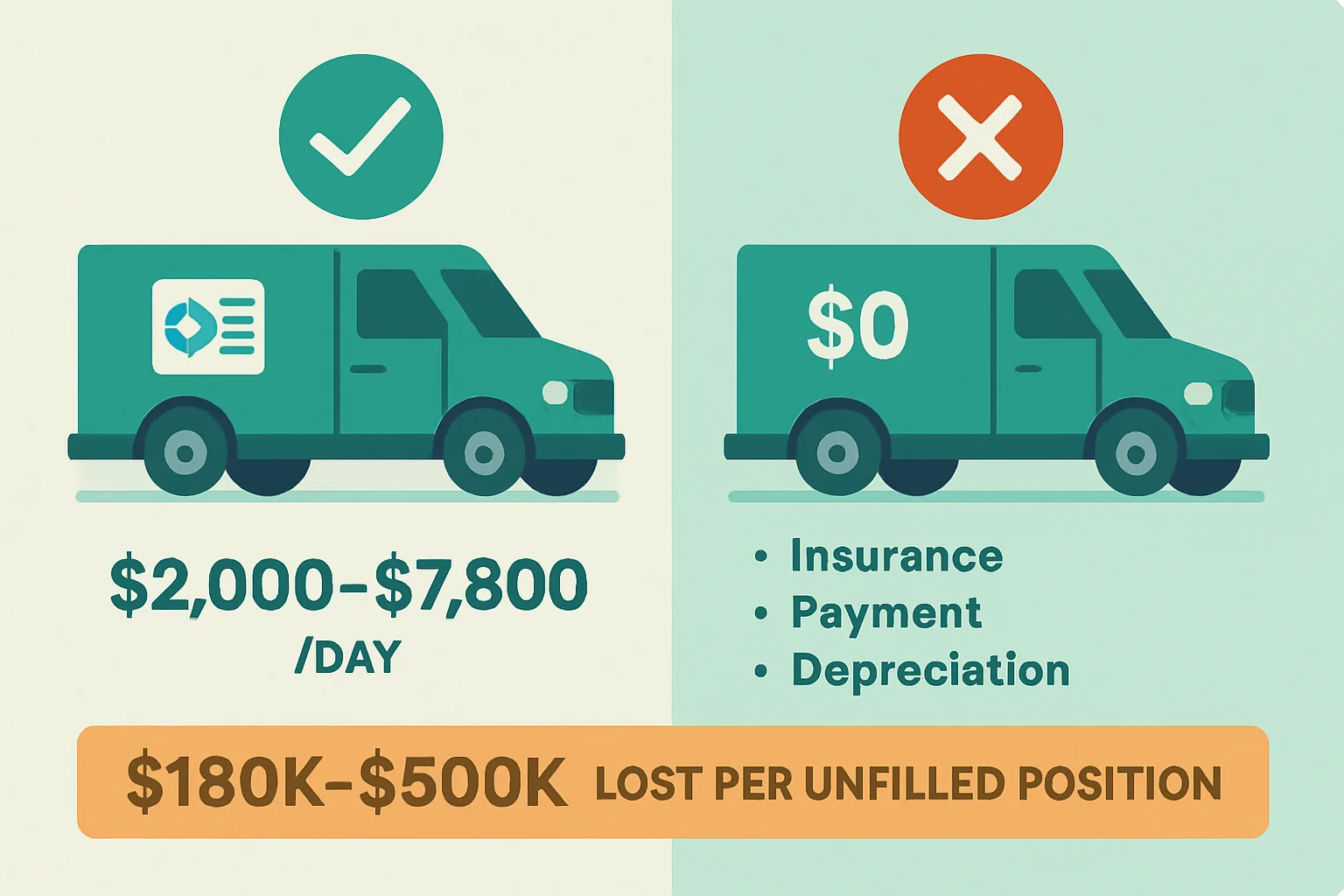
- Peak season (June–September, 120 days): $2,500/day x 120 days = $300,000 in lost revenue capacity per empty seat
- Off-peak adjustment: Factor in shoulder seasons and slower winter months, and you’re looking at $180,000–$500,000 in annual revenue loss per unfilled tech position
The compounding effect:
Empty trucks aren’t free. They still cost you:
- Vehicle insurance: $2,400–$4,800/year
- Loan or lease payment: $6,000–$12,000/year
- Depreciation on the upfit and tool stock
- Wasted dispatch capacity
The truck generates zero revenue but keeps generating costs. That’s a double hit to your margin.
A real example:
You’re looking at an 8-truck company. Two seats are unfilled. The seller is presenting revenue of $2.1M and telling you the business “used to do $2.8M” before the staffing issues.
That $700K gap isn’t theoretical upside. It’s a concrete problem you’re buying. Here’s what those two empty seats really mean:
- Lost revenue: $360K–$1M/year in capacity, depending on your market
- Carrying costs on idle trucks: $15K–$25K/year
- Recruiting cost to fill both seats: $10K–$30K (job postings, recruiter fees, sign-on incentives)
- Training and ramp-up time for new hires: 60–120 days to full productivity
- Customer attrition during the gap: some percentage of those “we used to serve” customers found someone else. They’re not coming back automatically.
Warning: When a seller tells you the business “has capacity for” more revenue than it’s currently generating, what they’re really telling you is that they couldn’t staff the trucks. That’s not an opportunity — it’s an inherited problem. Price accordingly.
How to Evaluate Workforce Stability During Due Diligence
This is where most buyers get lazy. They look at the P&L, they look at the fleet, they maybe ask for a customer list. They almost never do a proper workforce audit.
Don’t be that buyer. Here’s the due diligence checklist for workforce stability:
Headcount and tenure
- Request the full employee roster with hire dates — every technician, apprentice, helper, dispatcher, and office staff
- Calculate average tenure. If it’s under 2 years for the field crew, that’s a red flag. It means the current owner has been churning and replacing, and the people there now may not stick around for a new owner either.
- Identify key revenue-generating techs — usually the top 3–4 by billable hours or revenue. How long have they been there?
- Flag anyone hired in the last 6 months. They have zero loyalty to the business and near-zero switching cost.
Compensation benchmarking
Are the techs paid at market? Because if they’re not, they’re pre-loaded to leave the moment a PE-backed shop waves a signing bonus.
2026 benchmarks (adjust for your metro):
| Role | Low Market | Mid Market | High Market / Major Metro |
|---|---|---|---|
| Apprentice (Year 1–2) | $38,000 | $48,000 | $65,000 |
| Journeyman Tech | $65,000 | $85,000 | $120,000 |
| Senior / Lead Tech | $80,000 | $100,000 | $140,000 |
| Service Manager | $75,000 | $95,000 | $130,000 |
If the company you’re buying is paying journeymen $62K in a market where the going rate is $85K, those techs aren’t loyal. They’re stuck. And that changes the day a recruiter calls.
- Get a full compensation breakdown for every field employee: base pay, overtime history, spiffs, bonuses, commission structure
- Compare to local market rates using data from ACHR News salary surveys, local job postings, and recruiter feedback
Benefits comparison
PE-backed firms have set a new floor for benefits in HVAC. Your crew is aware of this even if you’re not.
- Health insurance: Does the company offer it? What’s the employer contribution? A $500/month employee premium is effectively a $6,000/year pay cut compared to a shop that covers 80%.
- Retirement: 401(k) with match? Simple IRA? Nothing? PE shops typically offer 3–4% match.
- PTO and sick leave: How many days? Is it actually usable, or is there a culture of “we don’t take days off”?
- Vehicle policy: Company trucks taken home, or do techs drive to the shop? Take-home trucks are a massive retention lever — it’s worth $5K–$8K/year in perceived value to the tech.

Turnover history
- Ask for three years of turnover data. How many techs left? Where did they go? Were they fired or did they quit?
- Annual turnover above 25% is a warning. Above 40% is a fire alarm. That’s not a staffing challenge — it’s a culture problem or a compensation problem, and both are expensive to fix.
- Ask specifically about techs who left for competitors. If three guys went to the same PE-backed shop in the last two years, you know exactly what’s happening.
Certifications and licenses
- EPA Section 608 certification — Universal, Type I, II, or III for every tech handling refrigerants (this is a legal requirement, not a nice-to-have)
- NATE certification — not required, but NATE-certified techs are more valuable and harder to replace
- State-specific licenses — journeyman and master licenses vary by state. Who holds them?
- The critical question: Who holds the qualifying license for the business? If it’s only the owner and they’re leaving, you have a problem. See the license trap guide for the full breakdown.
Non-compete agreements
- Do non-competes exist for key techs? Get copies.
- Are they enforceable in your state? The FTC’s evolving stance and state-by-state variation makes this a moving target. Get an attorney’s opinion on enforceability, not the seller’s assurance.
- If there are no non-competes at all, factor in the retention risk. Nothing stops your best tech from leaving on Day 2 and opening his own shop with your customer list in his head.
The loyalty test
This one’s not on any spreadsheet.
If the seller allows it — and you should push for this as a condition of the LOI — talk to the crew. Not a group meeting. One-on-one conversations. Ask them how they feel about the transition. Ask them what they’d want from a new owner.
Their body language tells you more than any financial statement. The tech who won’t make eye contact and gives one-word answers? He’s already got a counteroffer from someone else. The dispatcher who asks thoughtful questions about your plans? She’s invested. You can tell.
Warning: If the seller refuses to let you interact with employees before closing, that tells you something. Maybe they’re protecting confidentiality, which is reasonable. Or maybe they know the crew will say things that kill the deal. Push for at least meeting key staff under an NDA during the exclusivity period.
The PE Factor: Who You’re Competing With for Talent
You’re not just buying a company. You’re entering a talent war with opponents who have deeper pockets and a professional recruiting operation. You need to understand what you’re up against.
What PE-backed platforms are spending on recruitment:
- Signing bonuses: $5,000–$15,000 for experienced journeyman techs, higher in tight markets like Phoenix, Dallas, and the Southeast corridor
- Relocation packages: Some platforms are paying $3K–$8K to move techs from oversupplied markets to underserved ones
- Benefits packages that most independent shops can’t touch: full medical/dental/vision with low employee premiums, 4% 401(k) match, company truck, paid training, and career pathing
- Dedicated recruiters: PE-backed consolidators like Apex Service Partners, Sila Services, and NexStar-aligned platforms have full-time recruiting teams. They’re not waiting for your techs to apply. They’re calling them directly.
What PE can’t offer:
Here’s the good news. Money isn’t everything, and plenty of experienced techs know it.
- Small-company culture: No corporate layers, no standardized scripts, no mandatory upsell quotas. A lot of techs left corporate shops specifically to avoid that environment.
- Direct relationship with the owner: In a PE-backed platform, the “owner” is a regional manager who reports to an operations VP who reports to a board. In your shop, the owner is the person they can walk up to on Monday morning and tell things directly.
- Local community feel: Techs who’ve spent their career serving their own neighborhood take pride in that. Working for “Thompson Heating & Air” carries a different weight than working for “Apex Service Partners — Southeast Region, Unit 47.”
- Ownership pathway: This is the biggest card you can play. Offer profit-sharing, phantom equity, or a clear path to a minority stake for your top performers. PE can’t do that at the individual shop level.
- Flexibility: Doctor’s appointment? Leave early. Kid’s baseball game? Go. PE shops have PTO policies and HR departments. You can just be a reasonable human being.
Your competitive moat as an independent owner isn’t matching PE dollar-for-dollar. It’s building the shop that good techs don’t want to leave. For a deeper look at the PE competitive landscape, see our guide on competing with PE chains as an independent HVAC owner.
Retention Planning Starts Before You Close
If you wait until Day 1 to think about retention, you’re already behind. The best buyers build a workforce retention plan into their acquisition strategy during due diligence. For the complete retention playbook, see our guide on employee retention after acquisition.
The announcement
How and when you tell the crew about the ownership change matters enormously. Get this wrong and you’ll lose people before you even have the keys.
- Timing: The crew should hear it from you and the current owner together, in person, on the day of (or the day after) closing. Not before. Leaks create panic.
- Setting: All-hands meeting, short and direct. Then one-on-ones within 48 hours.
- Message: “Nothing changes for 90 days. Your pay, your schedule, your routes — all the same. I’m here to learn, not to blow things up.”
- The most important thing you can say: “I want every single person in this room to be here a year from now. My job is to make sure you want to be.”
Day-one retention bonuses
This is the highest-ROI check you’ll write.
- Structure: $2,000–$5,000 per field technician, split into two payments — 50% at 6 months, 50% at 12 months
- Cost for an 8-tech crew: $16,000–$40,000 total
- What it buys you: A year of stability while you learn the business, build relationships, and earn trust
- The alternative: Losing one senior tech costs you $80K–$150K in recruiting, training, and lost revenue. The retention bonus is cheap insurance.
For your top 1–2 revenue-generating techs, go higher. A $10,000 retention bonus for a tech generating $400K in annual billings is a 2.5% investment in protecting that revenue stream. No-brainer.
Compensation market adjustment
If your due diligence revealed that techs are underpaid — and in a lot of acquisitions they are, because the selling owner was milking margin in the final years — raise them to market immediately.
Not in 90 days. Not after you “see how things go.” Immediately.
- This is the single highest-ROI money you’ll spend post-close
- A $5,000/year raise for five underpaid techs costs you $25,000 annually
- Losing one of those techs because you waited costs you $80K–$150K
- The math is not complicated
Culture signals
You can’t buy loyalty. But you can earn it faster than you think.
- Show up on job sites. Don’t just sit in the office. Ride along on service calls. Watch how the work gets done. Ask questions.
- Buy lunch. Seriously. A $150 pizza order on Friday tells the crew more about you than any all-hands presentation.
- Fix something the old owner wouldn’t. Every shop has a thing — the broken break room fridge, the dispatch software everyone hates, the parts inventory system that runs on sticky notes. Fix one of those things in the first month.
- Learn names. Their spouses’ names. Their kids’ names. Whether they coach Little League or ride motorcycles. These are people, not headcount.
When Workforce Problems Should Kill the Deal
Not every staffing issue is fixable. Some are bad enough to walk away from. Here are the clear signals.
Walk-away signal: The owner IS the qualifying license holder and nobody else is certified
If the departing owner holds the only contractor license and no other employee can qualify the business, you have a ticking clock the moment they leave. In some states, that means you literally cannot pull permits or legally operate.
This isn’t a staffing problem. It’s an existential business risk. Read the full breakdown in our license trap guide.
Walk-away signal: More than 50% of the crew has been there less than a year
A crew that’s more than half brand-new means one of two things: there was a mass exodus recently (why?), or this is a revolving door operation where nobody sticks. Either way, you’re not buying a team. You’re buying a recruiting problem.
Walk-away signal: Key techs have already been recruited and are waiting to leave
This happens more than you’d think. A PE-backed shop makes offers to the top three techs. The techs accept conditionally — “I’ll come over once the sale closes.” They’re sitting in the building every day, collecting a paycheck, waiting for the green light to walk.
If you can get one-on-one conversations with techs during due diligence, read the room carefully. Evasive answers about “long-term plans” from senior techs should make your stomach drop.
Walk-away signal: Compensation is 20%+ below market with no retention mechanism
If the current owner is paying journeymen $60K in a $85K market with no non-competes, no retention bonuses, and no equity, those techs are staying purely out of inertia. A new ownership event is exactly the disruption that breaks inertia.
You’ll need to give everyone a raise to market on Day 1 — that’s an immediate $100K+ hit to your SDE — and even then, the transition anxiety might push people to take the PE offer anyway.
The honest math on post-close hiring
If your workforce audit reveals that you’ll need to hire 3 or more techs after closing, here’s what that actually costs:
| Cost Category | Per Tech | For 3 Techs |
|---|---|---|
| Recruiting (postings, fees, recruiter) | $3,000–$8,000 | $9,000–$24,000 |
| Sign-on bonus (competitive market) | $5,000–$10,000 | $15,000–$30,000 |
| Training and ramp-up (60–120 days at reduced productivity) | $15,000–$30,000 | $45,000–$90,000 |
| Lost revenue during vacancy (3–6 months) | $90,000–$250,000 | $270,000–$750,000 |
| Total true cost | $113,000–$298,000 | $339,000–$894,000 |
Add $150K–$300K minimum to your true acquisition cost for three unfilled positions. Now rerun your deal math. Does it still work at the asking price?
If not, either negotiate the price down by that amount or walk. “I’ll figure out staffing” is not a plan. Not in this market.
Warning: The seller will tell you the staffing problem is “temporary” or “easily solved.” Ask them why they didn’t solve it. If an experienced HVAC business owner with 20 years of industry relationships couldn’t fill those seats, what makes you think you will — as a brand-new owner with zero recruiting track record in that market?
The Bottom Line
The HVAC industry has always been a people business. But the labor shortage has turned a full, stable crew from a normal operating condition into a genuine competitive advantage — one that should directly impact what you’re willing to pay for an acquisition.
When you’re evaluating your next deal, look at the trucks and the P&L and the customer list. But spend just as much time looking at the people.
- Who’s on the crew?
- How long have they been there?
- Are they paid fairly?
- Are they being recruited?
- Will they stay for you?
If the answers are good, you might have found something rare: a fully-staffed HVAC company in a market where that’s worth its weight in gold.
If the answers are bad, you know exactly what to do. Discount the price, build a hiring plan with real numbers, or walk away. No deal is good enough to survive losing half the crew in the first six months.
The trucks are just metal. The people are the business.
For the full retention playbook post-close, see our guide on employee retention after acquisition. To adjust your offer price based on workforce factors, work through the acquisition math guide. And for the broader competitive landscape with PE consolidators, read competing with PE chains as an independent HVAC owner.