
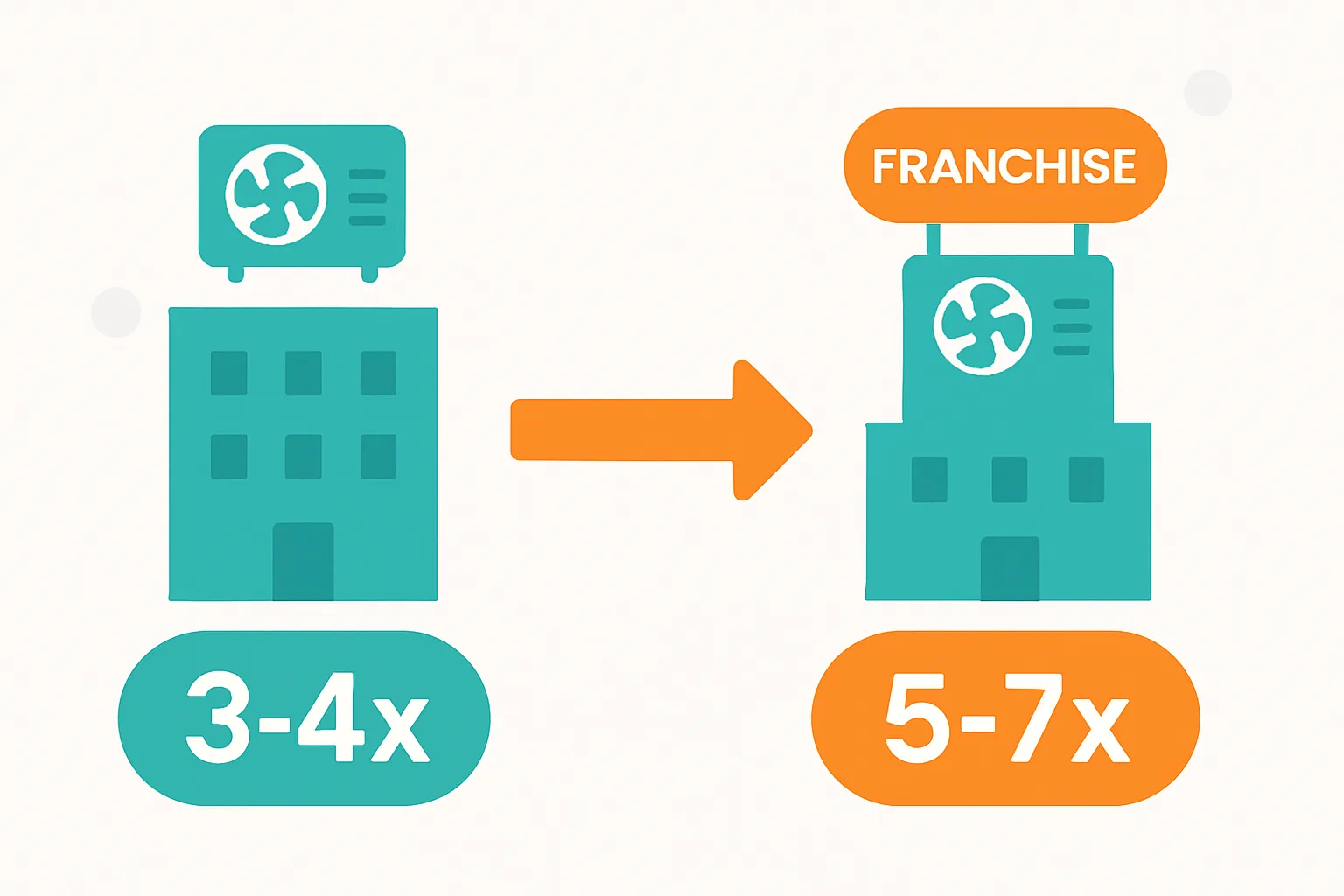
Buy an underperforming independent at 3–4x EBITDA, convert to a franchise system for $25K–$60K, and reposition your exit multiple from 3–4x to 5–7x. The royalties sting. The math still works.
You closed on an independent HVAC company. The trucks are yours, the customer list is yours, the headaches are yours. And three months in, you realize the previous owner ran everything out of his head, a spreadsheet, and a shoebox of receipts.
No CRM. No automated dispatch. No digital marketing beyond a dusty Google Business Profile. No brand recognition outside a 5-mile radius. You’re competing against franchise operations with $100K annual ad budgets while you’re hand-writing postcards.
Here’s the play that smart acquirers are executing right now: convert that independent shop to a franchise system for $25K–$60K, plug into national infrastructure overnight, and reposition your exit multiple from 3–4x EBITDA to 5–7x. The royalties sting. The math still works.
Why Franchise Conversion Beats Building From Scratch
Let me be direct about what you’re buying when you convert. You’re not buying a logo. You’re buying operational infrastructure that would cost you $200K+ and 18–24 months to build independently.
Here’s what lands on day one of conversion:
- National digital marketing engine — SEO, PPC, and LSA campaigns managed at the corporate level. Value: $50K–$100K annually if you hired an agency yourself.
- Integrated tech platform — ServiceTitan or Housecall Pro enterprise license, pre-configured with franchise workflows, pricing matrices, and reporting dashboards.
- Standardized pricing matrix — Flat-rate pricing books tested across hundreds of locations. No more guessing on change orders.
- Technician training infrastructure — Ongoing technical and sales training. NATE prep, comfort advisor scripts, membership plan selling frameworks.
- Branded fleet wraps and marketing collateral — Professional truck wraps, uniforms, yard signs, door hangers designed by national creative teams.
- Territory protection — Exclusive geographic territory. No other franchisee competes in your zip codes.
Only 20% of independent HVAC contractors operate on a single integrated tech platform. That stat should terrify you if you’re running an independent. It means 80% of your competitors who convert instantly leapfrog your operational maturity. Franchise conversion solves the tech stack problem overnight — no 6-month software evaluation, no painful data migration you manage yourself, no training your dispatcher on three different systems. If you’re still evaluating standalone options, read our guide on choosing the right tech stack for context on what you’re replacing.
The Franchise Systems Available for Conversion
Not every franchise wants converters. Some prefer greenfield (new startup) franchisees they can mold. These four actively recruit existing HVAC businesses:
One Hour Heating & Air Conditioning (Authority Brands)
- Conversion fee: $25,000
- Royalty: 6% of gross revenue
- Ad fund: 2% of gross revenue
- What you get: Authority Brands is a $2B+ home services platform. You’re joining a system with massive buying power, integrated call center support, and proven marketing playbooks.
- Best fit: Operators doing $1M–$5M who want aggressive growth support
- Learn more about their conversion program
Aire Serv (Neighborly)
- Conversion fee: $35,000–$45,000 (varies by market size)
- Royalty: 5% of gross revenue
- Ad fund: 2% of gross revenue
- What you get: Neighborly operates 30+ home service brands. Cross-referral network with Mr. Rooter, Mr. Electric, and others means leads flow between brands. The multi-trade valuation premium is real, and Neighborly gives you access to adjacent trades without buying another company.
- Best fit: Markets with strong Neighborly brand presence, operators who want cross-selling without multi-trade ownership
- Learn more about their conversion program
Service Experts
- Conversion fee: $25,000 (vs. $59,900 for greenfield)
- Royalty: 4–5% of gross revenue
- Ad fund: 2% of gross revenue
- What you get: Lower royalty rate than competitors. Strong in markets where they already have brand recognition from their corporate-owned locations.
- Best fit: Markets where Service Experts already advertises, operators focused on keeping royalty costs low
Conair HVAC
- Conversion fee: $30,000–$40,000
- Royalty: 5–7% of gross revenue (tiered by revenue)
- Ad fund: 1.5–2% of gross revenue
- What you get: Newer system with fewer territories sold. More negotiating leverage on territory size and terms. Less brand recognition but more room to grow within the system.
- Best fit: Operators who want franchise infrastructure without competing against 200 other franchisees for corporate attention
For a broader comparison of franchise vs. independent models, ServiceTitan published a solid breakdown of the operational differences.
The Exit Math: Where This Play Pays Off
Here’s why financially literate buyers are executing this strategy. The numbers aren’t subtle.
Independent HVAC company exit multiples: 3–4x EBITDA (sometimes lower for sub-$500K EBITDA businesses with owner dependency)
Franchise HVAC company exit multiples: 5–7x EBITDA (supported by transferable systems, brand equity, territory rights, and proven SOPs)
Run the numbers on a $400K EBITDA business:
| Scenario | Multiple | Enterprise Value |
|---|---|---|
| Independent exit | 3.5x | $1,400,000 |
| Franchise exit (conservative) | 5x | $2,000,000 |
| Franchise exit (strong market) | 7x | $2,800,000 |
The multiple expansion alone adds $600K–$1.4M in exit value. That’s before accounting for the revenue growth that franchise marketing and systems typically drive.
Yes, you’re paying 6–9% of gross revenue in royalties and ad fund contributions. On a $2M revenue business, that’s $120K–$180K annually. But if your EBITDA grows from $400K to $500K from better pricing, reduced callbacks, and higher close rates — and your exit multiple jumps 1.5–3x — the ROI on those royalties is enormous.
This is the same PE exit thesis that private equity firms use: buy at a low multiple, professionalize operations, sell at a higher multiple to a larger buyer. You’re just using a franchise system as your professionalization engine instead of a $300K consulting engagement.
The Conversion Timeline: 60–90 Days From Agreement to Operational
The process moves faster than most buyers expect. Here’s the typical sequence:
Weeks 1–2: Discovery and Mutual Evaluation
- Initial franchise disclosure document (FDD) review
- Discovery Day visit to franchise headquarters
- Territory availability confirmation
- Financial qualification review
Weeks 3–4: Agreement and Planning
- Sign franchise agreement
- Pay conversion fee
- Receive brand standards manual and implementation timeline
- Begin technology platform migration planning
Weeks 5–8: Implementation
- ServiceTitan/platform configuration and data migration
- Staff training (typically 3–5 days at franchise headquarters)
- Fleet wrap design approval and installation scheduling
- Marketing material production
- Website migration to franchise template
- Phone number porting to franchise call center (if applicable)
Weeks 9–12: Launch and Optimization
- Official brand launch in market
- Digital marketing campaigns go live
- First 30-day performance review with franchise business coach
- Pricing matrix optimization based on local market data
The 60–90 day window assumes clean operations. If you’re mid-acquisition and planning to convert post-close, build this timeline into your first 120 days of ownership.
When Franchise Conversion Does NOT Make Sense
I’d be doing you a disservice if I didn’t cover when to skip this play. Not every acquisition benefits from conversion.
You already have strong local brand equity. If the company you bought has 500+ Google reviews, strong name recognition, and a 20-year reputation — converting to “One Hour” or “Aire Serv” might actually destroy value. Customers who trust “Johnson Heating” don’t automatically transfer loyalty to a national brand.
Your systems are already sophisticated. If the acquired business already runs ServiceTitan with custom workflows, has a marketing agency generating $50K/month in attributed revenue, and maintains 85%+ first-time fix rates — what exactly is the franchise selling you? You’d be paying 6–9% for infrastructure you’ve already built.
The franchise brand has negative associations in your market. Google the franchise name + your city + “reviews.” If a previous franchisee flamed out locally and left a trail of 1-star reviews, you’re inheriting that baggage.
Territory conflicts exist. If the franchise already has an operator within 15–20 miles of your service area, your territory will be artificially constrained. Worse, you’ll compete against a same-brand operator for the gray-zone customers between your territories.
Your growth plan includes trades the franchise restricts. Some franchise agreements limit your ability to add plumbing, electrical, or other trades. If you’re planning to build a multi-trade operation, make sure the franchise agreement doesn’t box you in. Understand the manufacturer dealer relationships implications before you sign anything that limits your equipment options.
You’re planning to sell within 18 months. Franchise agreements typically have 10-year terms with transfer fees (usually $5K–$15K). If your exit timeline is aggressive, the conversion costs and ongoing royalties may not recoup before you sell.
How to Evaluate Which Franchise System Fits Your Acquisition
Not all franchises are equal. Here’s a structured evaluation framework:
Step 1: Map Your Gaps
What’s actually broken in the business you acquired? Rank these:
- Marketing and lead generation
- Technology and operational systems
- Pricing and margin optimization
- Technician recruiting and training
- Brand recognition and trust
The franchise that best addresses your top 2–3 gaps is your starting point.
Step 2: Talk to Existing Converters (Not Greenfield Franchisees)
The FDD lists every franchisee’s contact info. Call 5–10 who converted from independent operations. Ask:
- How long until the marketing investment showed ROI?
- What surprised you about the transition?
- Would you do it again knowing what you know now?
- What’s your actual EBITDA margin after royalties?
Step 3: Model the 5-Year Economics
Build a simple model:
- Current revenue × expected growth rate (franchise average vs. your independent projection)
- Subtract royalties and ad fund (6–9% of gross)
- Add back: marketing spend you’ll eliminate, software costs covered by franchise, reduced training costs
- Calculate net EBITDA impact
- Apply franchise exit multiple vs. independent multiple to projected Year 5 EBITDA
If the net present value of the franchise path beats the independent path by 20%+, the conversion makes financial sense.
Step 4: Review the FDD Like a Buyer, Not a Joiner
Pay attention to:
- Item 19 — Financial performance representations. What do existing franchisees actually earn?
- Item 7 — Total initial investment. What costs beyond the conversion fee?
- Item 6 — Ongoing fees. All of them. Technology fees, call center fees, required vendor purchases.
- Item 12 — Territory rights. How big? How protected? Can they sell overlapping territories?
- Item 17 — Renewal and transfer. What happens when you sell?
Financing the Conversion
The SBA loves franchise businesses. The SBA Franchise Directory lists approved franchise systems, and most major HVAC franchises are on it. This means your conversion fee — and often the entire acquisition — qualifies for SBA 7(a) financing.
Here’s how acquirers typically structure it:
- Acquisition financing: SBA 7(a) loan for the business purchase (up to $5M)
- Conversion fee: Rolled into the acquisition loan or paid from working capital
- Fleet wraps and rebranding: Often financed separately or cash-flowed from operations
If you’re evaluating how franchise conversion affects your loan structure, Lendesca is a solid resource for understanding how SBA lenders view franchise acquisitions vs. independents. Franchise deals often get favorable treatment in underwriting because of the proven system and brand support — lenders see lower risk.
Frequently Asked Questions
Can I convert to a franchise if I haven’t closed on the acquisition yet?
Yes. Many buyers negotiate the franchise agreement concurrently with the acquisition. Some franchise systems will issue a conditional approval pending your business purchase closing. This lets you factor conversion costs into your total acquisition budget.
Do I lose my existing customer database when I convert?
No. Your customer data stays yours. The franchise provides the platform (usually ServiceTitan enterprise) and helps you migrate existing records. You maintain ownership of your customer relationships — the franchise provides the tools to serve them better.
What happens to my existing employees during conversion?
Nothing changes in their employment status. They get new uniforms, new truck wraps, and attend training. Most technicians appreciate the structure, training investment, and career path that franchise systems provide. The franchise doesn’t hire or fire your staff.
Can I negotiate the franchise agreement terms?
Conversion candidates have more leverage than greenfield franchisees. You’re bringing existing revenue, an established team, and market presence. Negotiate on: territory size, royalty phase-in periods, marketing co-op credits for the first year, and transfer fee caps.
What if I want to exit the franchise system later?
Read Item 17 of the FDD carefully. Most agreements have a 10-year initial term. Early termination typically means paying remaining royalties for a set period (often 12–24 months). Some systems allow de-identification — you remove their brand and continue independently — but you lose the exit multiple premium.
How do royalties work during slow months?
Royalties are calculated on gross revenue, not profit. During low-revenue months (shoulder seasons), your effective royalty rate on profit is higher. Model this seasonality into your cash flow projections. Some systems offer royalty relief programs for the first 6–12 months post-conversion.
Will the franchise restrict which equipment brands I can install?
It depends on the system. Some franchise agreements include preferred vendor relationships with specific manufacturers (Carrier, Trane, Lennox). These often come with better dealer pricing. Others allow equipment flexibility. Clarify this before signing — if you have strong existing manufacturer relationships, you don’t want to lose favorable pricing tiers.
The Bottom Line
The franchise conversion play works when the math works. Buy an underperforming independent at 3–4x EBITDA. Spend $25K–$60K converting to a franchise system. Accept 6–9% in ongoing royalties. In exchange, you get $100K+ in annual marketing value, operational systems that took the franchise decades to refine, and — critically — an exit multiple that’s 1.5–3x higher than where you started.
You’re not paying royalties. You’re buying multiple expansion.
Run the 5-year model on your specific deal. If the exit value increase exceeds your cumulative royalty payments by 2x or more, the conversion is a no-brainer. If it’s closer to breakeven, stay independent and build your own systems.
The acquirers getting rich in HVAC right now aren’t the ones with the best wrenches. They’re the ones who understand that a business is worth what the next buyer will pay for it — and franchise buyers pay more.
For more on the exit multiple dynamics at play here, the PE exit thesis guide covers how private equity firms use the same buy-low-sell-high strategy. If you’re still weighing whether to stay independent, our tech stack guide covers building your own operational infrastructure without franchise royalties. And for context on how franchise-adjacent models compare, the franchise vs. independent acquisition guide breaks down the manufacturer dealer relationship dynamics.