
There are $31 billion in annual federal contracting dollars earmarked for people like you. Most HVAC buyers with veteran or minority status never touch a penny of it. That ends today.
You've spent years in the trade, or you've spent years in uniform, or both. You understand how HVAC systems work. You understand how to manage people under pressure. You understand what it costs to build something from the ground up.
What nobody told you is that the federal government has spent the last two decades building a financial architecture specifically designed to put you into business ownership. Certification programs. Sole-source contracting set-asides. Mission-driven lenders. Reduced SBA fee structures. State-level grant programs with no equivalent for conventional buyers.
Most of that infrastructure goes unused. Not because the programs don't work — they do. Because nobody markets them to the people who qualify.
This is the briefing you should have gotten before you started your acquisition search.
The Numbers Most HVAC Buyers Never See
Let's start with scale, because most people think these programs are tiny. They're not.
The federal government's SDVOSB (Service-Disabled Veteran-Owned Small Business) program carries a statutory goal of 5% of all federal contracting spend directed to certified veteran-owned businesses. At current federal contracting volumes, that's approximately $31 billion annually. The government routinely misses that goal — which means there's persistent pressure from Congress to push more contracts toward certified businesses.
The SBA's 8(a) Business Development Program for minority-owned businesses allows sole-source contract awards up to $4.5 million without competitive bidding. A contracting officer can write you a check for a $4.5M HVAC services contract and not open it up to competition. That is not a typo.
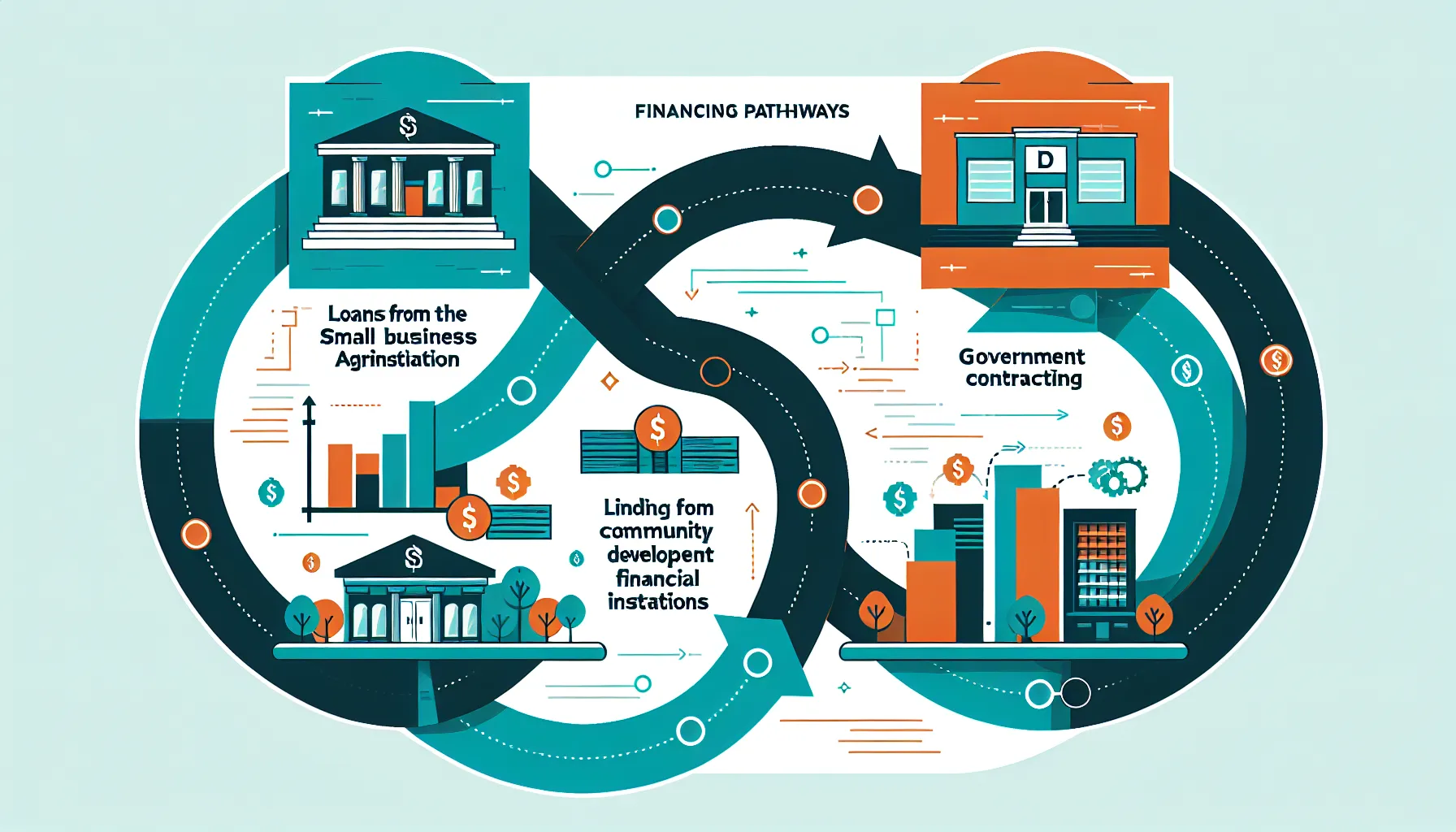
The CDFI Fund — Community Development Financial Institutions — deployed over $400 million in FY2024 to underserved borrowers. These are real lenders making real loans to people who don't fit the conventional bank profile. We'll cover them in detail later.
Why HVAC specifically? Because the federal government has an enormous physical plant to maintain.
- Military bases require continuous HVAC maintenance and upgrade contracts. Every installation has a multi-million-dollar HVAC service need.
- VA hospitals are among the most HVAC-intensive facilities in existence — medical-grade air handling, strict humidity control, 24/7 operation.
- Federal office buildings have aging equipment and significant deferred maintenance backlogs.
- Department of Energy buildings are under pressure to reduce energy consumption, which means equipment replacement contracts.
HVAC work is classified under NAICS codes that appear constantly in federal contracting databases. The work is real, recurring, and geographically distributed. Which means there's likely a federal facility near whatever market you're looking to acquire in.
SDVOSB Certification — What It Is and How to Get It in 12 Days
If you're a service-disabled veteran, this is the most powerful certification available to you. And it's faster than most people think.
What SDVOSB actually means
SDVOSB stands for Service-Disabled Veteran-Owned Small Business. To qualify, you need to:
- Have a service-connected disability rating from the VA (any rating — 0% qualifies as long as it's officially service-connected)
- Own at least 51% of the business
- Control the day-to-day management and long-term decision-making
- Be a U.S. citizen
The "control" requirement is real and gets scrutinized. If you're bringing in a partner who's going to run operations while you're a passive majority owner, you may not qualify. The person with the disability needs to be in the seat.
VetCert: 12-day processing
The SBA's VetCert program now processes most straightforward SDVOSB applications in approximately 12 days. That's a dramatic improvement from the old system, which took months and had a backlog that made people give up.
You'll submit:
- DD-214 (Certificate of Release or Discharge)
- VA disability rating letter
- Business formation documents
- Operating agreement showing ownership and control provisions
- Federal tax returns for the business (if already operating)
If the business doesn't exist yet — if you're in the middle of an acquisition — you can apply using a letter of intent and the formation documents for your new entity. SBA guidance allows for pre-acquisition certification processing in many cases. Worth calling the VetCert help line to clarify your specific situation before you close.
What SDVOSB certification actually buys you
The contracting advantages are concrete:
- Sole-source awards up to $4 million — contracting officers can award HVAC service contracts to you without competitive bidding
- Set-aside competitions — contracts reserved only for SDVOSB businesses, eliminating most of your competition
- Priority in contract bundling reviews — when the government consolidates contracts, certified small businesses get consultation rights
- State-level equivalents — most states have their own veteran preference programs with separate set-aside pools
A concrete example: A veteran-owned HVAC company operating near a mid-sized military base in the Southeast earns $800K–$1.2M per year just in base facility maintenance contracts. That's before a single residential service call. The base needs someone certified, someone local, someone they can reach at 2am when the barracks HVAC goes down in July. That someone might as well be you.
The SBA 8(a) Program for Minority HVAC Buyers
If you're a socially and economically disadvantaged business owner — and "socially disadvantaged" has a specific legal definition that includes race, ethnicity, gender, and other characteristics — the 8(a) program is a nine-year runway with tools most buyers never imagine.
Who qualifies
The SBA 8(a) Business Development Program serves individuals who are:
- Socially disadvantaged: members of groups that have faced systemic discrimination (Black Americans, Hispanic Americans, Native Americans, Asian Pacific Americans, and others — the list is expansive)
- Economically disadvantaged: personal net worth below $750K (excluding retirement accounts and primary residence equity), adjusted gross income averaging below $350K over three years, total assets below $6M

Owning a profitable HVAC business does not automatically disqualify you from 8(a) — the personal financial thresholds are what matter for eligibility, not the business revenue.
You must own at least 51% and control the business. You need to have been in business for at least two years prior to applying, OR demonstrate the management experience necessary to operate without a track record.
The mechanics that change your acquisition thesis
Once certified, the 8(a) program gives you:
- Sole-source contracts up to $4.5 million — no competition, direct award from a federal agency
- Competitive set-aside contracts — bid only against other 8(a) firms
- Mentor-protégé program — pair with a larger company that provides bonding capacity, equipment, technical assistance
- 9-year program term — four years in the "developmental stage," five years in the "transitional stage"
Here's what that means practically. An HVAC company doing $1.8M per year in residential and light commercial service might look like a solid lifestyle business. The same company with an 8(a) certification that wins two federal facility maintenance contracts is doing $4M per year with significantly better margins on the government work. The acquisition thesis just changed completely.
Federal HVAC contracts pay on net-30 terms, often with automatic price escalators tied to inflation indices. The commercial side of your revenue becomes more predictable. The business becomes more financeable. And when it's time to sell, the certified contract backlog commands a premium.
The 8(a) certification takes longer to obtain than VetCert — plan for 90 days. If you're structuring an acquisition, you may need to account for this in your transition timeline.
CDFI and Mission-Driven Lending — When Your Story Matters More Than Your FICO
Traditional SBA lenders are not the only path. And in some cases, they're not the right path.
What CDFIs are
Community Development Financial Institutions are Treasury-certified lenders — banks, credit unions, and loan funds — whose mission is capital deployment to underserved markets. The CDFI Fund certifies them, provides federal subsidies, and requires them to serve borrowers that conventional banks won't touch.
These are not charities. They underwrite deals. They charge interest. They expect repayment. The difference is how they underwrite.
A traditional bank looks at your FICO score, your collateral, and your liquid assets. If those three boxes don't check out, the conversation ends before they ever look at the deal you're trying to buy.
A CDFI looks at the whole picture: business viability, your background and relevant experience, the community impact of the transaction, your capacity to operate, and — yes — your creditworthiness, but weighted differently in a holistic assessment.
Who CDFIs serve
CDFIs have explicit mandates to serve specific populations. Many explicitly prioritize:
- Minority-owned businesses
- Veteran-owned businesses
- Women-owned businesses
- Low-to-moderate income communities
- Rural markets underserved by conventional banking
If you check any of those boxes, you have direct access to a pool of capital that exists specifically to fund deals like yours. The challenge is finding the right institution.
How to find CDFI lenders
The CDFI Fund maintains a searchable database at cdfifund.gov. Filter by geography and business lending. Look for CDFIs that specifically list small business acquisition as an eligible use — not all of them fund acquisitions.
Typical CDFI terms for HVAC acquisition financing:
- Loan amounts: $50K–$1.5M (varies significantly by institution)
- Rates: Prime + 2–5% (generally higher than SBA, lower than hard money)
- Terms: 5–10 years on acquisition loans
- Equity injection: Often 10–15% required, but flexible on source (gifts, community investors, seller notes may count)
- Credit minimums: Often 600–640 instead of the SBA's effective floor of 660–680
Some CDFIs also offer revenue-based financing for working capital components — advances repaid as a percentage of monthly revenue. This is particularly useful for the first 90 days post-acquisition when you're rebuilding cash reserves.
If you're having trouble navigating the CDFI landscape or want to understand how mission-aligned lending pairs with more conventional financing, Lendesca specifically works on connecting underserved buyers with the right lending pathways. Worth a look if you're at the point of stacking a financing structure.
Veteran-Specific SBA Advantages Beyond SDVOSB
Even if you're not service-disabled — or while you're waiting on SDVOSB certification — the SBA has several veteran-specific programs worth knowing.
SBA Veterans Advantage
Veterans Advantage reduces the guarantee fees on SBA 7(a) loans. Specifically:
- For loans under $150K: the upfront guarantee fee is waived entirely
- For loans $150K–$500K: the guarantee fee is reduced to 0% for veterans (conventional borrowers pay 2%)
- For loans above $500K: the standard fee structure applies, but the VA home loan entitlement calculation may be affected separately
These aren't massive numbers in absolute terms, but on a $400K acquisition loan, a 2% fee savings is $8,000 at closing. That's cash staying in your pocket.
Boots to Business Reboot
The SBA's Boots to Business Reboot program (run in partnership with the Institute for Veterans and Military Families at Syracuse University) provides free entrepreneurship training specifically designed for veterans already in civilian business environments. The curriculum covers business planning, financing, market analysis, and operational management.
It won't teach you HVAC, but it will teach you how to evaluate a deal, build a business plan lenders actually believe, and present yourself as a credible borrower. For a tech who's great with equipment but new to the acquisition process, this is worth the time.
State-level veteran preference programs
Every state has its own small business development infrastructure. Many states have veteran-specific programs with features like:
- Bid preference points on state government contracts (often 3–5% price preference)
- Certifications that mirror federal SDVOSB but apply to state procurement
- Grant programs — not loans — that provide equity injection capital without repayment
Research your state's small business development center (SBDC) and your state's Department of Veterans Affairs website. The programs vary significantly by state. In California, Virginia, Texas, and Florida — states with large veteran populations and active procurement offices — the state-level programs can be nearly as valuable as the federal ones.
The Acquisition Playbook — How Identity-Based Advantages Change Your Deal Structure
These programs don't just help you finance the deal. They change the deal itself.
Entity structure matters — plan it before you close
SDVOSB and 8(a) certifications are tied to your business entity and its ownership structure. You need to think about this before you form your acquisition LLC or S-Corp.
For SDVOSB: The eligible individual must own at least 51% and maintain unconditional control. No provisions that allow a minority owner to override major decisions. No preferred stock or equity classes that dilute practical control. Your operating agreement needs to be drafted by an attorney who understands certification requirements — not a generic online template.
For 8(a): Similar ownership and control requirements. Additionally, consider whether bringing in a silent investor or an SBA-funded partner will affect your disadvantaged status calculation.
If you're doing a co-buyer deal — which is common when you need to meet the equity injection requirement — structure it carefully. A conventional partner with 49% ownership may be fine for SBA 7(a) purposes but create complications for SDVOSB certification. Get this reviewed before the ink dries on your LOI.
Certification timing relative to close
Timing matters more than most buyers realize.
SDVOSB: Apply as early as possible. The 12-day processing assumes a clean, straightforward application. Complex ownership structures, missing military records, or businesses with unusual organizational documents can extend it. Apply during due diligence, not after close.
8(a): The two-year business history requirement means that if you acquire an existing business, you may need to demonstrate that the pre-acquisition business history transfers to your new entity. This depends on how the acquisition is structured — asset purchase vs. stock purchase, and whether the government contracting past performance follows the entity. Get a federal contracting attorney involved.
Pairing government and residential revenue
The optimal HVAC acquisition under these programs isn't a pure commercial play or a pure government play. It's a residential service base that generates predictable cash flow, combined with government contract revenue that scales the business.
Here's why this matters for your acquisition search:
- A company with 80% residential service agreements is easier to operate day-one
- Adding federal contracts in year one or two layers high-margin revenue on top of a stable base
- The diversified revenue stream is more attractive to lenders at acquisition time AND to buyers when you eventually exit
When you're understanding the financial side of acquisition, pay particular attention to the revenue concentration analysis. You want to know not just how much revenue is government-derived, but whether existing contracts are transferable and whether the seller has an existing SDVOSB or 8(a) certification that terminates at closing.
Due diligence additions for certified buyers
Standard HVAC due diligence covers equipment condition, maintenance agreements, workforce, and financials. When you're planning to pursue federal contracting, add these:
- Existing government contracts: Are they transferable? What are the novation requirements? Who's the contracting officer?
- Past performance records: The seller's CPARS ratings (Contractor Performance Assessment Reporting System) don't automatically transfer, but they can be referenced in your initial proposals
- GSA schedule eligibility: Does the business qualify for a GSA schedule? Has the seller ever pursued one?
- Facility clearance requirements: Some defense contracts require facility clearances that take 6–18 months to obtain. Know what you're walking into.
- Small business size standards: HVAC businesses are evaluated under NAICS codes with specific employee count and revenue thresholds. Know your NAICS codes and confirm you'll meet the size standards post-acquisition.
Look at what the asking price actually buys you through this lens. A certified business with existing government contracts may justify a premium price — or the seller may be unaware that their certification terminates at ownership change, which means the government revenue is not as certain as it appears.
Financing stack for certified buyers
Most certified buyers are leaving money on the table by using a single financing source when they could stack multiple.
A layered structure might look like this:
- SBA 7(a) primary loan (with reduced veteran guarantee fee): 80% of purchase price
- Seller note (see seller financing structures): 10% of purchase price
- CDFI working capital loan: Covers operating expenses for 90 days post-close
- Equity injection: 10% from personal savings, retirement funds, or state grant programs
The total you're financing is the same. But by using veteran fee reductions, a CDFI for working capital, and a state grant to cover part of the equity injection, you may substantially reduce the out-of-pocket cash needed at closing and preserve more capital for the first-year operations that always cost more than you expect.
For buyers whose SBA path is complicated, alternative financing beyond SBA lays out the options when conventional lending channels aren't working.
Exit premium for certified businesses
Here's the part nobody talks about because most buyers aren't thinking about exit on day one. They should be.
A veteran-owned or minority-owned HVAC business with active certifications, established government contracting past performance, and a GSA schedule is worth more when you sell it than an otherwise identical business without those credentials.
The buyer pool is larger — larger HVAC consolidators actively seek certified companies because they can use that certification as a vehicle to access government set-asides. Private equity firms building HVAC platforms have learned that a certified small business subsidiary can win contracts the parent company can't touch.
Build these certifications in from the start. Pursue government contracts systematically. Document your past performance. When you sell in year seven, those credentials are a negotiating asset, not an administrative burden.
The Bottom Line
The financing and contracting advantages available to veteran and minority HVAC buyers are not small. They're not symbolic. They're structurally significant enough to change what deals you can close, how you finance them, and how much the business is worth when you eventually sell.
The programs exist. The money is deployed every year. Most of it goes to people who either knew about the programs or had advisors who did.
Now you know.
Start with your certifications — SDVOSB if you're a service-disabled veteran, 8(a) if you're a socially disadvantaged minority business owner. Run both tracks in parallel if you qualify for both. Engage a federal contracting attorney for the entity structuring questions. Find your regional CDFI. Talk to your state SBDC.
Then go buy the business.
This article covers certification strategy and contracting advantages. For a complete picture of HVAC acquisition financing, read the related guides on understanding the financial side of acquisition, seller financing structures, and what the asking price actually buys you.