

The first site visit is the highest-signal hour of the entire acquisition. Most buyers waste it. Use this as your walk-in checklist.
Here’s the uncomfortable truth about HVAC acquisitions: a seasoned owner can learn more about a business in 45 minutes on-site than a green buyer learns from two months of due diligence.
That’s not magic. It’s pattern recognition. After 20 years in the trade, certain things jump out — the way the shop smells, how techs move through the parts area, what’s written on the whiteboard in the dispatch room, whether the seller flinches when you ask about a specific supplier.
You can’t fully compress 20 years of pattern recognition into a checklist. But you can get 80% of the way there by knowing what to look at, what to ask, and what to photograph before you leave.
This guide is that checklist.
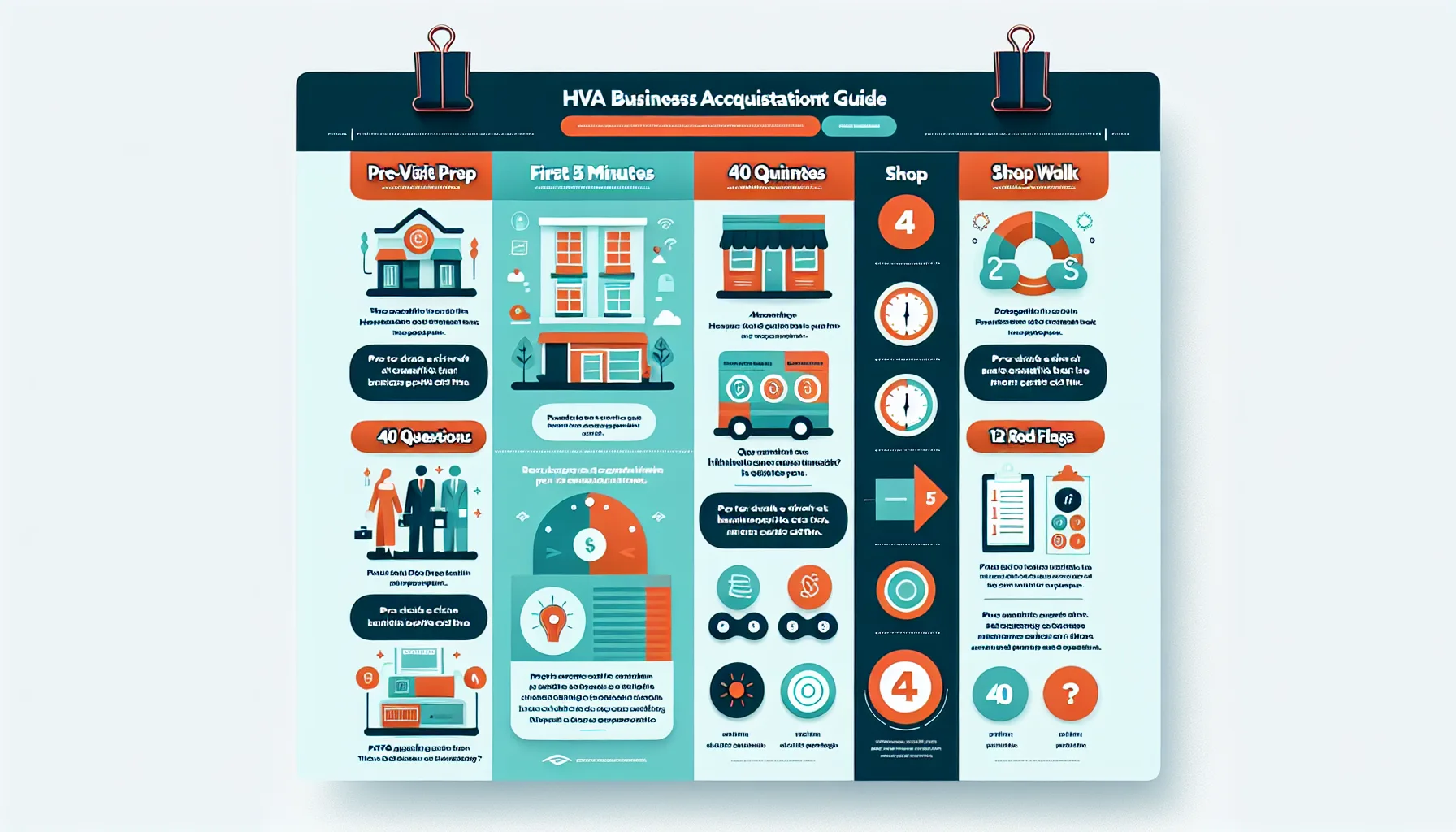
Before You Go: The Three Things to Lock Down
1. Get an NDA signed
You’re about to see financials, customer lists, and internal processes. Don’t show up without a signed mutual non-disclosure. If the seller hasn’t provided one, your attorney can send a one-page version. The SBA’s guide to buying a business covers the basics of what due diligence should include. Takes an hour.
2. Read the teaser and listing in detail
You should know going in:
- Stated asking price
- Reported revenue and seller’s discretionary earnings (SDE)
- Employee count
- Customer mix (residential / commercial / new construction)
- Square footage of the shop
- Vehicle count
Walk in with questions, not a notepad full of items you could have Googled. The seller will size you up in the first ten minutes.
3. Set expectations on the visit itself
Ask the seller ahead of time:
- “Can we walk the shop, the bays, and any on-site fleet during the visit?”
- “Would you be open to a 10-minute conversation with your service manager or head dispatcher?”
- “Can I see the dispatch board during a live shift?”
If any of those get a hard no, that’s data. Not necessarily disqualifying, but worth noting.
When You Arrive: The First Five Minutes
You’ll learn more in the parking lot than you think.
- How many vans are actually there? A 10-van business where 10 vans are parked at 10:00 a.m. on a Tuesday is either slow or you’ve arrived during a safety meeting. Ask which.
- What does the exterior of the building look like? Cracked sealant, peeling paint, broken signage, weeds through the lot. If the owner can’t maintain their own building, that tells you something about how equipment is maintained.
- What’s the energy like when you walk in? People looking busy, phones ringing, radio traffic from dispatch? Or a receptionist scrolling on her phone in a quiet lobby?
Don’t over-index on vibe. But don’t ignore it either.
The Shop Walk: What to Actually Look At
The tour will feel fast. Slow it down. Your photos are your record — take a lot of them (with permission).

Parts and inventory area
- Is it organized? Labeled shelves, bin locations, inventory stickers? Or piles on the floor?
- Any obvious obsolete inventory? Dust-covered boxes of R-22 equipment (no longer used), old control boards for 2008-era furnaces, aftermarket parts for brands the seller no longer services. Photograph it.
- Ask: “How do you count inventory and reconcile it against the books?” The right answer is some version of “quarterly.” The wrong answer is “I just know what’s in here.”
Service bays and vehicle maintenance area
- Are vans being worked on, or is this a just-for-the-tour moment? Ask if you can see the last three months of fleet maintenance records.
- Look at floor condition. Oil stains, missing lift pads, corroded air compressor lines. Safety equipment missing is an OSHA problem you’ll inherit — and OSHA violations transfer with the business in an asset purchase.
Dispatch / office area
- The whiteboard is gold. Techs’ names, jobs assigned, time stamps, any red or circled items. Photograph it (with permission). You’ll learn more about the business from the board than from the income statement.
- Phone traffic. Is the phone ringing? Is someone answering it on the first ring? How fast is the dispatcher booking? If the phone is dead on a weekday, either the business is slow or the lead flow has dried up. Ask.
- Check the dispatch software screen. How many open jobs? How many unassigned? How far out is the schedule booked? This maps directly to revenue velocity.
Owner’s office
- Where are the financial records? Shoebox? Binder? QuickBooks on a single laptop that only the owner can log into? This tells you what your quality-of-earnings work is going to involve.
- What’s on the walls? Industry awards? Photos of the owner with employees? A Chamber of Commerce plaque from 1997? Old things are signals — some good (longevity, community ties), some bad (nothing new has happened in 10 years).
The 40 Questions to Ask in Person
Split these across the visit. Don’t machine-gun them in one sitting — interleave them with the walk and let the seller breathe.
Financial reality (1–10)
- “How has revenue trended the last three years? Do you have a month-by-month P&L?”
- “What’s your SDE and how did you calculate it?”
- “Walk me through your add-backs. What’s in there?”
- “What’s been your best month ever and what caused it?”
- “What’s been your worst month in the last three years and what caused it?”
- “What’s your gross margin on service vs. installs vs. maintenance agreements?”
- “How much of your revenue comes from your top 10 customers?”
- “Do you have any customers who are more than 90 days past due? What’s the process?”
- “When did you last take a price increase, and how did it land?”
- “What’s been your largest single-year uncollectible write-off?”
Operations and workflow (11–20)
- “Walk me through a typical service call from the phone ringing to invoicing.”
- “How many calls does each tech run per day on average? What’s your spread — low, median, high?”
- “What’s your dispatch software, and how long have you been on it?”
- “How do you handle after-hours and weekend emergency calls? Is that profitable or a loss leader?”
- “What percent of techs hit their pricebook targets?”
- “Who closes the books? You or your CPA?”
- “How often do you physically walk the shop and ride along on calls?”
- “What’s one operational thing you’ve been meaning to fix for two years but haven’t?”
- “What’s one thing you do really well that you think a new owner would break?”
- “If you couldn’t come in tomorrow, what breaks first?” (This is maybe the most revealing question on the list.) For companies with commercial revenue, pay special attention to auditing the commercial estimating function — it’s often the most concentrated key-person risk in the business.
People (21–30)
- “How long has each of your top five employees been with you?”
- “Are any of them family members or related by marriage?”
- “What’s turnover been the last two years? Techs, dispatchers, office staff separately?”
- “How many techs do you feel like you could lose before the wheels come off?”
- “Any employees currently underperforming? What’s the plan?”
- “How are techs paid — hourly, spiff-based, commission, salary? Walk me through the pay plan.”
- “Who holds the master license? Is that person selling with you or staying?”
- “Any current or pending workers’ comp claims? Any active lawsuits?”
- “How’s your workers’ comp experience mod trending?” The NCCI experience rating methodology is the standard reference — a mod above 1.0 means you’re paying above-average premiums. (See why this matters.)
- “Tell me about the last employee you had to let go and why.”
Customers, marketing, and the brand (31–35)
- “Where do your new leads actually come from? Google, referrals, yellow pages, LSA?”
- “What’s your Google review count and average? When was the last negative review and what was it about?” (See the reputation transfer guide.)
- “What’s your active maintenance agreement count and monthly recurring revenue from them?” (Detailed in the service agreement valuation piece.)
- “If the big-box competitor or a PE roll-up opened a branch across town tomorrow, how would that affect you?”
- “What’s your marketing budget as a percent of revenue?”
The seller themselves (36–40)
- “What’s the real reason you’re selling now — not the press release version?”
- “How long are you willing to stay on in a transition role, and what does that look like for you?”
- “Are there any deals or verbal commitments I need to know about that aren’t written down?”
- “What would a great outcome for this sale look like from your perspective?”
- “If I were to talk to your top three customers about the business, what would they tell me?”
That last one matters more than it looks. Don’t literally call the customers — but the seller’s hesitation or comfort answering it is the tell.
12 Red Flags That Should Make You Slow Down
Not all of these are dealbreakers. But each one is a negotiating lever, a diligence flag, or a reason to revise your offer.
- The seller can’t cleanly articulate why they’re selling. “I’m just ready to retire” is fine. “Well, it’s complicated” is not.
- Stated revenue and observed operational tempo don’t match. If the business “does $2.5M” but you see three techs running about one call each when you visit, do the math. Revenue is $2.5M on paper, but it might be $1.8M on the ground.
- Owner does dispatch, sales, and accounting personally. Owner dependency is a valuation killer. The more roles the owner holds, the more value walks out with them.
- No written employment agreements or non-competes with key techs. Your highest-producing tech could walk to a competitor the day after close and take customers. Note that the FTC’s non-compete rule is in legal limbo — check current enforceability in your state before relying on non-competes as protection.
- Financials are “mostly on paper.” QuickBooks that stops at 2022. Shoebox of receipts. Bank statements that don’t reconcile. This is a quality-of-earnings nightmare and usually a price concession.
- Seller is defensive about specific line items. Travel expenses, vehicle expenses, owner’s spouse on payroll for an unclear role. Ask once, note the reaction, ask again later. The family shop informal-org-chart piece walks through what to expect here.
- Fleet is under-maintained or mismatched. Mixed-brand vans of different model years with no clear replacement plan. You’re buying deferred capex.
- Maintenance agreement base is concentrated or stale. “We have 1,200 maintenance agreements” means nothing if 40% haven’t been visited in 18 months. Pull the list. Sort by last service date.
- Commercial concentration risk. One commercial customer that’s 30%+ of revenue is a valuation haircut, period.
- Workers’ comp mod above 1.0. Ask why and what’s changed. Mod rates above 1.2 suggest a safety culture problem, which compounds into hiring difficulty.
- Open permits or jobs-in-progress that aren’t cleanly tracked. You may inherit warranty obligations on work you didn’t do. Most states require mechanical contractor license holders to pull permits — verify who holds the license and whether open permits transfer.
- Seller wants cash-heavy structure and short transition. A seller confident in the business will stand behind a meaningful earnout or seller note. A seller pushing for 100% cash at close and a two-week handoff is either untrusting of the business or eager to exit a problem.
What to Photograph Before You Leave
Ask permission, but ask:
- The dispatch whiteboard
- The parts inventory area (wide shot + close-up of any visibly dusty boxes)
- The fleet in the lot (license plates / van numbers visible if possible)
- The back of at least two vans (organization, tools, branded vehicle wrap condition)
- Any permit boards, license certificates, state registrations posted in the office
- The exterior signage and the building itself
- Any awards, certifications, or trade association plaques (dates matter)
Back at home, dump these into your deal folder alongside your notes. You will reference them a dozen times during due diligence.
After the Visit: Your 48-Hour Ritual
- Write your gut impression within one hour. What did the business feel like? Healthy? Tired? Defensive? Welcoming? Capture it before the emotion fades. You’ll need this when you’re 10 weeks into diligence and losing perspective.
- List everything the seller said that you couldn’t verify. Every claim — revenue, margin, employee tenure, customer concentration — goes on a list for the quality-of-earnings engagement.
- List everything you observed that contradicts the story. Even small contradictions.
- Rank the visit on a 1–10 “would I buy this” gut scale. Write that number down. Compare to how it evolves as diligence progresses.
What a Great Site Visit Actually Looks Like
A green buyer shows up hoping the seller likes them. A seasoned buyer shows up having already decided what they need to see — and uses the visit to confirm or disconfirm.
You’re not there to be charmed. You’re not there to fall in love with the business. You’re there to answer one question: is what the seller is selling the same as what I’m considering buying?
If you leave with a clear answer either way, the visit did its job. The worst site visit is one where you leave more confused than when you arrived — that usually means you let the seller drive the conversation.
Go in with this list. Use it. You’ll spot in 45 minutes what most buyers miss over six months.