
You’ve charged R-410A a thousand times. But when you’re buying a business, every pound of it on the balance sheet and every system in the field tells a different story than it did two years ago. Here’s what the transition means for your deal.
You Know Refrigerants. Now Think About Them Like a Business Owner.
You’ve been recovering, charging, and leak-checking R-410A for years. You know the pressures, the saturation temps, the quirks. As a tech, the phase-down means new equipment to learn and updated certifications to earn. Annoying, but manageable.
As a buyer, it means something completely different.
The business you’re evaluating has an R-410A inventory position — condensing units and bulk refrigerant sitting in a warehouse, priced at what they cost six or twelve months ago. It has a fleet of installed systems in the field that need servicing with a refrigerant that’s getting more expensive every quarter. And it has a transition cost that nobody — not the seller, not the broker, not the listing — is putting in front of you.
This isn’t a future problem. The manufacturing ban on new R-410A equipment hit January 2025. The installation deadline for split systems was January 2026. If you’re reading this in 2026, the clock has already run.
The bottom line: Refrigerant transition risk is a real, quantifiable cost in every HVAC acquisition happening right now. If your due diligence doesn’t account for it, you’re overpaying.
The R-410A Timeline: What’s Already Happened and What’s Coming
Here’s where things stand. No speculation — just what’s already locked in under the AIM Act and EPA regulations.
Already in effect
- January 1, 2025: Manufacturing of new R-410A residential and light commercial systems ended. Distributors can sell remaining inventory, but the pipeline is finite.
- January 1, 2026: Installation deadline for R-410A split systems. After this date, newly manufactured R-410A split systems cannot be installed. (Units manufactured before the cutoff can still be installed until stock runs out.)
Coming soon
- January 1, 2028: Installation deadline for R-410A packaged/rooftop units. Same rule — manufactured before the cutoff is okay, but the supply dwindles.
The refrigerant supply picture
- R-410A production was slashed roughly 30% in 2024 under the EPA’s HFC phase-down allocation.
- Wholesale R-410A prices are up 40–70% compared to 2022 levels, depending on region and supplier.
- Reclaimed and recycled R-410A will be available for years, but at premium pricing.
- Service refrigerant is not banned. You can charge R-410A into an existing system for as long as that system runs. It’s just going to cost more every year.
The replacements
- R-454B (trade name: Opteon XL41) — the primary residential/light commercial replacement. Lower GWP, similar performance characteristics.
- R-32 — used in some equipment lines, especially from manufacturers with global platforms.
- Both are A2L classified — mildly flammable. No retrofit path from R-410A. You can’t drop R-454B into an R-410A system. Period.
- New R-454B-compatible systems cost 15–25% more than the R-410A equipment they replace. That premium will narrow over time, but it’s real right now.
What This Means for the Business You’re Evaluating
Every HVAC business on the market right now is in some stage of this transition. Some are ahead. Most are not. Here’s what to look at.
Existing inventory
What R-410A equipment is sitting in the warehouse?
- Split systems manufactured before the cutoff could still be installed (until 1/1/26, which has already passed for splits). Anything left is either being sold at clearance or sitting there losing value.
- Bulk R-410A refrigerant is usable for service but depreciating in practical terms — it costs more to buy today, but the margin on service calls may not reflect that yet.
- Ask the hard question: how much R-410A inventory is on the books, what did they pay for it, and what’s it actually worth today?
A seller listing $80K in inventory at cost when half of it is unsold R-410A split systems is not listing $80K in inventory. It might be $50K. Or $35K.
Installed base
How many R-410A systems did this company install in the last 10–15 years?
Every single one of those systems will need R-410A service refrigerant at rising prices for the remainder of its lifespan. That’s both an opportunity and a risk:
- Revenue opportunity: Higher refrigerant costs mean higher service ticket totals — if the business has updated its pricing. A 5-lb top-off that cost the customer $150 two years ago should be $250+ today.
- Margin squeeze: If the business is still charging 2022 rates but paying 2025 refrigerant costs, margins are getting eaten alive. Check the service pricing schedule against current refrigerant purchase costs.
Technician readiness
Are the techs ready for A2L refrigerants?
- R-454B requires updated EPA Section 608 certification that covers A2L handling.
- A2L refrigerants need different safety training — leak response, ventilation requirements, ignition source control during service.
- This isn’t optional. If you’re buying a business and planning to sell and install new systems, your techs need this training before they touch R-454B equipment.
Equipment and tools
R-454B doesn’t just need different knowledge. It needs different gear.
- Recovery machines rated for A2L refrigerants
- Leak detectors calibrated for R-454B (your R-410A electronic leak detector won’t cut it)
- Updated gauge manifolds and hoses
- Potentially updated service vans — some jurisdictions require A2L-specific storage and ventilation configurations
- Code compliance: check whether your local jurisdiction has adopted the updated mechanical codes (based on 2024 UMC/IMC) that allow A2L refrigerants in occupied spaces
If this equipment checklist sounds like your site visit walkthrough, it should — walk the vans and check what’s actually there.
How to Evaluate Refrigerant Risk in Due Diligence
Add these eight items to your diligence checklist. Every one of them is a document request or a question you can ask in the first LOI meeting.
1. Request the R-410A inventory list
Get a line-item list of all R-410A equipment in stock — model numbers, quantities, purchase dates, and purchase prices. Separately, get the bulk refrigerant inventory (how many pounds, what they paid per pound, current market value per pound).
2. Get the installed base report
How many R-410A systems are under active service agreements? How many total R-410A systems has the business installed in the last 15 years? This tells you the size of the service revenue tail — and the size of the future replacement opportunity.
3. Ask for refrigerant purchase history (last 3 years)
This shows two things: volume (how much refrigerant the business goes through) and cost trend (whether they’re paying 2022 or 2025 prices). If they bought 500 lbs in 2022 at $8/lb and 400 lbs in 2025 at $14/lb, that’s a 75% unit cost increase on a core consumable. Has the pricing to customers kept pace?
4. Check tech certifications
Ask for each technician’s EPA Section 608 certification status. Specifically ask about A2L training completion. If nobody has it, that’s a transition cost. If half the team has it, that tells you the business has at least started.
5. Review the equipment list
Are recovery machines, leak detectors, and gauge sets R-454B compatible? Walk the service vans. This takes an hour and tells you exactly where you stand on equipment spend.
6. Ask about supplier relationships
Does the business have an R-454B supply agreement with a distributor? Allocation matters — in the early transition period, distributor relationships determine whether you can actually get next-gen equipment when customers want it. A business with an established R-454B supplier relationship has a real advantage over one that hasn’t made the call yet.
7. Check local building code adoption
Has your jurisdiction adopted the updated mechanical code versions that allow A2L refrigerants in residential occupied spaces? Some jurisdictions are behind. If the local code doesn’t yet permit A2L installations, you have a timing problem — you can’t sell R-454B systems even if you have them.
This varies wildly by state and municipality. Don’t assume. Call the building department.
8. Review service pricing
Pull the current service price list and compare it to refrigerant costs. Specifically:
- What does the business charge per pound for R-410A on a service call?
- What did that refrigerant cost the business per pound on the last purchase order?
- What’s the markup?
If the markup hasn’t been updated since 2022, the business is leaving money on the table — or worse, losing margin. That’s both a problem and an opportunity. If you fix the pricing post-close, you may immediately improve SDE.
For more red flags to watch for during your evaluation, see our guide to HVAC acquisition red flags and deal killers.
The Opportunity Nobody’s Talking About
Here’s where this gets interesting.
Every R-410A system installed in the last 15 years — residential and commercial — will eventually need to be replaced with an R-454B or R-32 system. There is no retrofit. There is no drop-in replacement. When that compressor dies in year 12 or that condenser coil fails in year 14, the customer has a choice: find increasingly expensive R-410A service refrigerant for a patch, or replace the whole system with next-gen equipment.
Most of them will replace.

The math on the replacement wave
- The average residential HVAC system lasts 15–20 years.
- R-410A has been the standard residential refrigerant since roughly 2010 (it became mandatory for new systems in 2010, and most manufacturers switched by 2015).
- That means the first big wave of R-410A end-of-life replacements starts around 2025–2030 and runs through 2035–2040.
If the business you’re buying installed 2,000 R-410A systems over the last 15 years, some meaningful percentage of those homeowners will call the same company for the replacement. At an average replacement ticket of $8,000–15,000 per system, even converting 20% of that installed base is a $3.2M–6M revenue pipeline over the next decade.
That’s not a guess. Those systems exist. They’re aging. They will need replacement. The question is whether you’re the company they call.
This is a competitive moat
The businesses that position for this wave early — the ones that are already selling R-454B systems, training their techs, and building the supplier relationships — will capture a disproportionate share of the replacement market.
The businesses that are still running out R-410A inventory and hoping the transition takes care of itself? They’ll be scrambling when the volume hits.
If you’re acquiring a business right now and you invest in the transition immediately, you’re buying the moat. You’ll be the company in the territory with trained techs, equipment in stock, and a track record of next-gen installations while your competitors are still figuring it out.
That’s worth something. Factor it into your five-year revenue projections, not just your cost analysis. The energy code compliance shift is driving the same direction — heat pumps and next-gen refrigerants are the future, and the businesses that move first will win.
Negotiating the Refrigerant Transition Into Your Deal
You’ve done the diligence. You know the transition cost. Now use it.
Adjust the offer price
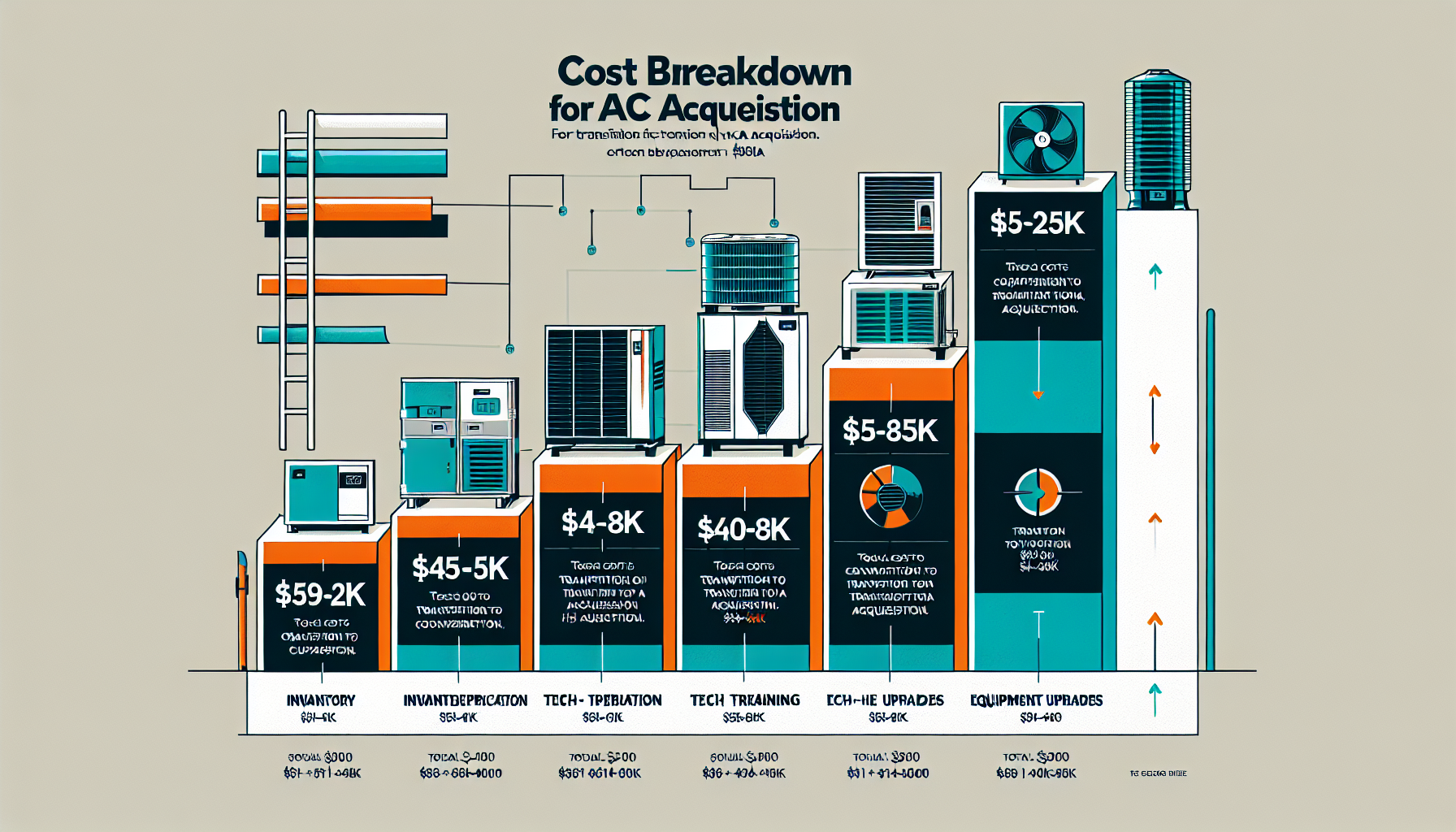
If your analysis shows $130K in transition costs that the business hasn’t incurred yet, that’s a legitimate basis for a price adjustment. You’re not lowballing — you’re accounting for a real, documented cost that the next owner will bear.
Frame it plainly: “The business needs $130K in investment to complete the refrigerant transition. That cost doesn’t appear in the current financials. We’d like to adjust the purchase price to reflect it.”
Some sellers will push back. Some won’t. Either way, you’ve anchored the conversation with real numbers instead of vibes. For a deeper look at how to run the acquisition math and adjust your offer, that’s covered in detail separately.
Request seller representations
In the purchase agreement, ask for representations that:
- All inventory is accurately stated and in sellable/usable condition
- The seller has disclosed all known regulatory changes affecting the business
- Refrigerant inventory quantities and condition are as represented
Standard stuff, but it creates accountability and a mechanism for post-close adjustments if the inventory turns out to be worth less than stated.
Consider an inventory holdback
If there’s significant R-410A equipment inventory, propose a holdback — a portion of the purchase price held in escrow for 90–120 days while you assess actual sellability and condition of that inventory. If it moves at stated value, the holdback releases to the seller. If it doesn’t, you have protection.
Budget for post-close CapEx
Your lender (SBA or otherwise) needs to understand the transition costs. Build a post-close capital expenditure budget that includes:
- Tech training and certification: timeline and cost
- Equipment upgrades: per-van cost and rollout schedule
- Initial R-454B inventory stocking
- Marketing the new capability to existing customers
This isn’t just for the lender. It’s your 90-day action plan. The faster you complete the transition, the sooner you start capturing the replacement wave revenue.
Use the gap as leverage — and opportunity
If the business hasn’t started transitioning, that’s negotiating leverage. The seller is essentially passing the cost and risk to you.
But it’s also opportunity. A business that’s behind on the transition is priced based on its current state. If you buy it at a transition-adjusted price and then execute the transition well, you’ve increased the value of the business on day one.
I’ve seen this movie before with the R-22 to R-410A transition. The shops that moved first printed money. The ones that waited got squeezed.
Frequently Asked Questions
Can I still service R-410A systems after the phase-down?
Yes. Indefinitely. The phase-down restricts manufacturing and installation of new R-410A equipment. It does not restrict servicing existing R-410A systems. You can charge R-410A into a system for as long as the refrigerant is available and the system is running. The cost of the refrigerant will rise, but the work is legal and will be necessary for years.
Is R-410A going to become unavailable?
Not in the near term. Even as virgin R-410A production decreases under the phase-down schedule, reclaimed and recycled R-410A will remain available. The EPA’s reclamation requirements are designed to keep service refrigerant in the supply chain. Prices will continue climbing, but outright unavailability is unlikely before 2035 at the earliest.
Should I avoid buying a business that hasn’t started the A2L transition?
Not necessarily. A business that’s behind on the transition may actually be a better deal — if you price it correctly. The key is knowing the cost of the transition, factoring it into your offer, and having a plan to execute it post-close. What you should avoid is paying full price for a business and then discovering the transition cost after closing.
How long until R-410A systems are fully replaced in the field?
Expect 12–15 years for the majority of the installed R-410A base to turn over through normal end-of-life replacement. Systems installed in 2020–2024 will be running well into the 2035–2040 range. That means R-410A service will be a revenue stream for at least another decade — and the replacement wave will build steadily over that same period.
What’s the biggest mistake buyers make with the refrigerant transition?
Ignoring it entirely. Most listing memorandums and broker presentations don’t mention refrigerant transition costs. Most sellers don’t bring it up voluntarily. If you don’t ask the eight diligence questions above, you will not get the information you need to price the deal correctly.
Does the refrigerant transition affect the business’s SDE?
It should, but it often doesn’t show up yet. Rising refrigerant costs eat into margins on service calls if pricing hasn’t been updated. Transition CapEx hasn’t been spent, so it doesn’t appear in historical financials. That means the trailing SDE may overstate the true earning power of the business unless you adjust for the coming costs. Run your own pro forma with updated refrigerant costs and transition expenses included. Our financial literacy guide walks through how to read and adjust those numbers.
The R-410A phase-down is the biggest operational shift in residential HVAC since the R-22 sunset. If you’re buying a business right now, it’s not optional homework — it’s the first page of your diligence binder. Get the numbers, do the math, and price the deal accordingly. The transition is a cost today and a revenue wave tomorrow. Position for both.


