

Every first-time owner walks in planning to take home their old paycheck plus the profit. Almost none of them actually can. Here’s what the math really looks like — and how to set your comp so the business survives year one.
Ask a tech what they expect to make the year after they buy an HVAC business and you’ll hear some version of this:
“Well, I was making $90K as a lead tech. And the business SDE is $400K a year. So I figure I’ll pay myself $90K salary and keep the rest. That’s like $400K in my pocket. Minus some taxes.”
Dear first-time owner: none of that is how it works.
Not because you’re wrong about the numbers. You’re right about them. But between “gross cash available” and “what lands in your personal checking account” there’s a stack of obligations that every new owner underestimates — SBA debt service, working capital, taxes at two different levels, reinvestment for stuff you didn’t budget for, and a little cushion for the summer the compressor in your shop dies.
Understand this math before you close. Not after. The buyers who get it right set their comp with clear eyes and sleep fine. The buyers who get it wrong spend year one cannibalizing working capital to pay themselves, hit a bad month in month nine, and start missing lender covenants.
Let’s walk through what owner compensation actually looks like in year one of an HVAC acquisition, with real numbers.
Start With the Four Buckets
Money that comes out of the business in year one goes into one of four places:
- Debt service — principal and interest on SBA and seller notes
- Working capital reserve — keeping enough cash in the business to make payroll and buy parts without drawing a line of credit
- Taxes — at the business level (if applicable) and passed through to you
- Your compensation — everything that lands in your personal checking account
Bucket #4 — your pay — is the last bucket filled, not the first. Every new owner instinctively wants to fill it first. Every experienced owner fills it last. That order is the single biggest mindset shift in going from employee to owner.
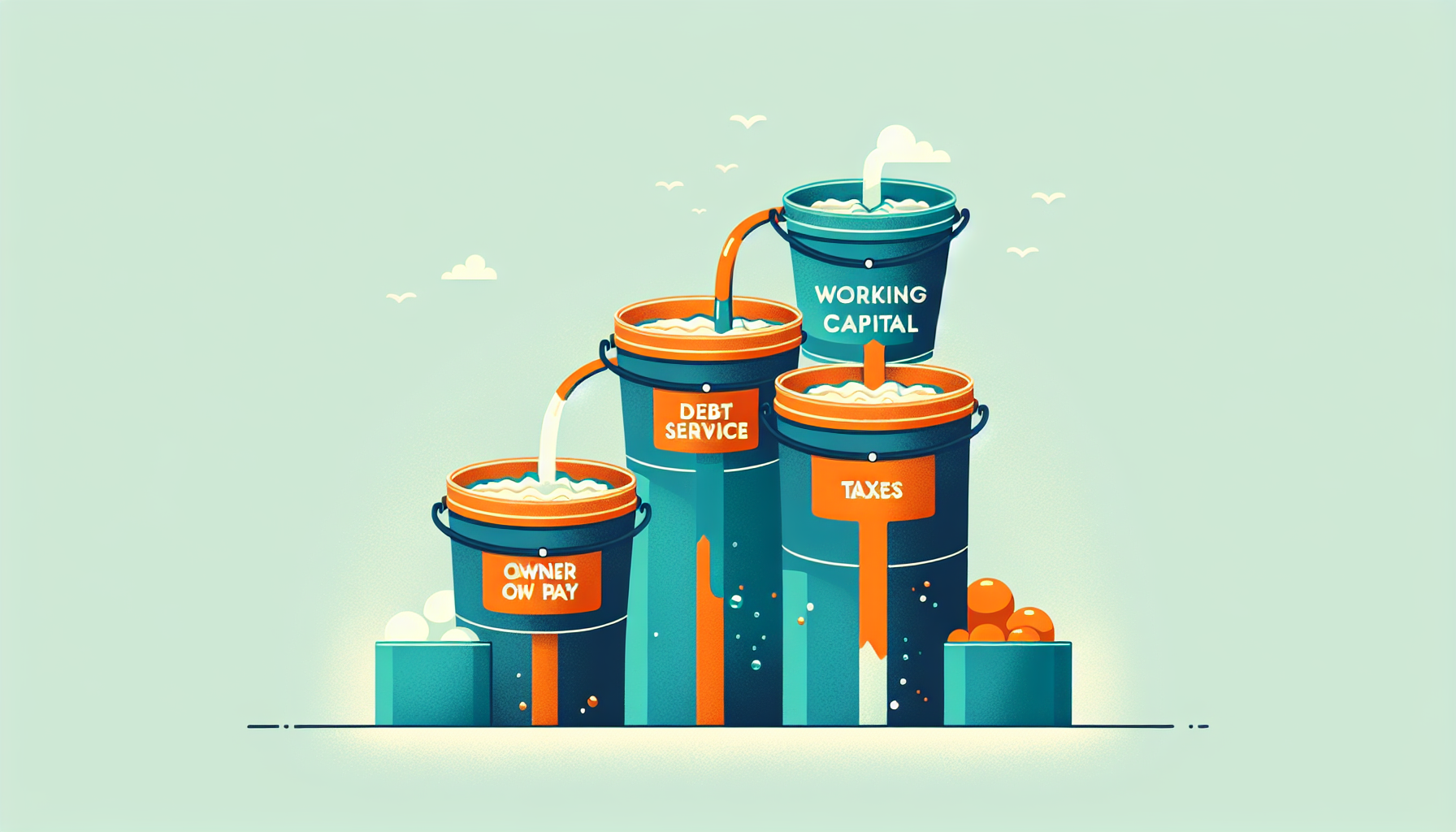
Let’s put numbers on each bucket for a realistic $1.2M HVAC acquisition.
The Example Deal: $1.2M HVAC Business
Assume you’re buying a residential/light-commercial HVAC business with these numbers:
- Revenue: $1.8M / year
- Seller’s Discretionary Earnings (SDE): $450K / year
- Purchase price: $1.2M (about 2.7x SDE — fair for a clean, mid-size deal)
- Deal structure:
- 10% buyer down payment: $120K
- 75% SBA 7(a) loan: $900K over 10 years at ~11%
- 15% seller note: $180K over 5 years at 7%
- Working capital included in sale: $75K
Now walk the buckets.
Bucket 1: Debt Service
Annual debt payments:
- SBA 7(a): $900K × 10-year amortization at 11% ≈ $149K/year ($12,400/month)
- Seller note: $180K × 5-year amortization at 7% ≈ $43K/year ($3,560/month)
- Total debt service: ~$192K/year
Right away, nearly $200K of that $450K SDE is gone — before you’ve paid yourself a dime. This is the piece that blindsides most buyers.
For lender math, you also need DSCR (debt service coverage ratio). The SBA wants DSCR ≥ 1.25 — meaning your post-acquisition cash flow must be at least 1.25x your debt service. Run the math: $450K SDE ÷ $192K debt = 2.34x. You’re fine on paper. But “fine on paper” does not mean “fine in your bank account.”
Bucket 2: Working Capital Reserve
HVAC is a seasonal, labor-heavy business. You need operating cash on hand to cover:
- Payroll (two pay periods minimum): $50K–$80K depending on crew size
- Parts and inventory: $30K–$60K
- Vehicle and equipment repairs: $10K–$20K budget
- Fuel, insurance, rent, utilities: $15K–$25K/month cycle
A general rule: keep at least 8 weeks of fixed costs in the bank. For this business, that’s roughly $100K–$150K sitting in the operating account at all times. You bought the business with $75K of working capital already in place. You need to build that to $100K+ in year one without pulling it out to pay yourself.
Budget: ~$40K retained for working capital build in year one if starting from $75K. More if the business is seasonal and you need a bigger summer cushion.

Bucket 3: Taxes
Here’s where the entity structure matters. If you bought as an S-corp or LLC taxed as S-corp (see the entity structure guide):
- The business doesn’t pay federal income tax directly
- Profits pass through to you personally
- You pay both self-employment tax (on your reasonable W-2 salary) and income tax on distributions
A $450K SDE business will likely pass through $150K–$250K of taxable income after depreciation, interest, and your W-2 salary. At combined federal + state + self-employment rates of ~30–37%, you’re looking at:
- Owner tax reserve: ~$50K–$75K/year (quarterly estimated payments)
Important: this money has to be set aside from the business, either in a separate tax reserve account at the business or reserved against your draws. The IRS safe harbor rules on estimated taxes require quarterly payments — miss one, eat a penalty.
Bucket 4: What’s Left for You
Running the math:
- SDE: $450K
- Minus debt service: -$192K
- Minus working capital build: -$40K
- Minus tax reserve: -$65K
- Available for owner compensation: ~$153K
That’s your year-one take-home before any reinvestment in fleet, software, or capex. If the shop needs a new van ($50K), a CRM upgrade ($20K setup), or a crash in AR collections ($30K gap), it comes out of that $153K.
So the realistic year-one take-home on a $450K SDE business is closer to $100K–$150K, not the $400K the naive math suggests.
That is still a raise from being a lead tech. Don’t lose sight of that. But it’s nothing like the number you walked in expecting.
The W-2 vs. Distribution Split
Now that you know the total amount you can pay yourself, you have to split it between salary (W-2) and distributions. If you’re set up as an S-corp or an LLC taxed as S-corp, this split has real tax consequences.
Why It Matters
- Salary (W-2) is subject to payroll taxes — about 15.3% combined Social Security and Medicare
- Distributions are NOT subject to payroll taxes — just income tax
So paying yourself more in distributions and less in salary saves ~15% on the distribution portion. Simple math says: minimize salary, maximize distributions.
The IRS caught on to that strategy decades ago and now requires owner-employees to pay themselves a “reasonable salary” before taking distributions. Set your salary too low and you can get hit with back payroll taxes, penalties, and interest.
The “Reasonable Salary” Benchmark for HVAC Owners
For a hands-off, leading-from-the-office HVAC owner: $85K–$120K/year is typical, depending on market and business size.
For a hybrid role where you’re still running calls or supervising techs on-site: $100K–$140K/year is more defensible.
The benchmark should reflect what you’d pay a general manager doing your job if you hired one. Document this reasoning — save salary surveys, local job postings, industry reports — so if the IRS ever asks, you have a paper trail.
Putting It Together
Using the example above where you have $153K available for comp:
- W-2 salary: $100K (reasonable for a small-shop owner)
- Distribution: $53K
- Combined: $153K
- Payroll tax savings: ~$8K/year vs. paying yourself all salary
That $8K is real money — but more importantly, this structure is defensible in an IRS audit because the $100K salary is benchmarked.
The SBA Wrinkle
If you financed with an SBA 7(a) loan, read this section twice.
SBA lenders often include a covenant in the loan agreement that limits owner distributions in year one — typically requiring the borrower to retain a minimum level of working capital, or to not take distributions until certain DSCR milestones are hit.
Common year-one covenants include:
- No distributions until trailing-12-month DSCR ≥ 1.5x
- Minimum working capital of $X on the balance sheet
- W-2 salary capped at seller’s historical owner comp (prevents you from overpaying yourself at the lender’s expense)
- Tax distributions allowed (you get to cover your pass-through tax bill) but profit distributions restricted
Read your loan docs. Have your attorney read them. Know the covenants before you close, and build your personal budget around them. Violating a covenant can trigger technical default — even if you’re making every loan payment on time.
More on SBA mechanics in our personal guarantee risk guide.
The Three Biggest Mistakes First-Year Owners Make
Mistake #1: Paying Yourself What You Think You’re Worth, Not What the Business Can Support
You were making $90K as a tech. You took on $1.2M of personal-guaranty debt. You feel like you should make way more. You deserve to make more.
The business might not agree with you yet.
Year one, your pay is capped by cash flow, debt service, and working capital needs — not by what you “deserve.” Get through year one intact, prove the business can sustain your old level of SDE (or more), and by year two you’ll have real room to increase comp.
Mistake #2: Taking Draws Instead of Setting Up a Structured Pay Plan
Some new owners wing it: take money when they need it, put money back when things are tight. This almost always ends in a tax mess and a distorted view of business health.
Set up a regular payroll — twice a month or monthly — with withholdings. Set your salary as a fixed number. Take distributions on a scheduled cadence (quarterly is fine). Stop the “I’ll just pull $5K this weekend” habit. It’s cleaner for your books, your taxes, and your lender.
Mistake #3: Not Building the Tax Reserve
Every dollar you take as a distribution is taxable. If you take a $50K distribution in March without also sending $15K to the IRS as an estimated payment, you’re going to owe that money next April plus a penalty.
Open a separate bank account just for tax reserves. Every time a distribution hits your personal account, move ~25–30% of it into the tax reserve. Pay estimated taxes quarterly from it. Never touch it for anything else.
This habit alone will save new owners thousands in penalties and panicked April filings.
When You Can Actually Give Yourself a Raise
You’ll want to. You’ll see money coming in and think I earned that. Hold the line until you can answer yes to all of these:
- Debt service is current and comfortable (DSCR above 1.5x for four straight quarters, not just one)
- Working capital is fully built (at least 8 weeks of operating expenses in the bank)
- One full seasonal cycle has passed — if you’re in a market with a winter or a summer that defines the business, you need to see how a full year handles before assuming the next one will too
- You’ve reinvested in obvious capex gaps — the fleet replacement cycle, the software upgrade, the safety equipment that was out of date
If all four boxes are checked, you’ve earned a comp adjustment. A typical pattern: bump W-2 salary by $10K–$20K in year two, increase distribution cadence, and use the year-end profit to either pay down the seller note early or take a structured bonus.
What About Spouse-on-Payroll Strategies?
A common small-business move is to put a spouse on payroll for a part-time role (bookkeeping, admin) to shift some income and open up a second retirement account. Legal, but:
- The role has to be real and the pay has to be reasonable
- You create additional payroll tax obligations
- It complicates your books
For a year-one owner still finding their footing, the simpler setup is cleaner. Revisit the spouse-on-payroll play in year two with your CPA once the business is stable.
The Retirement Piece Nobody Mentions
New owners usually stop contributing to retirement accounts in year one because “the business needs the cash.” That’s a mistake with compounding consequences.
Open a Solo 401(k) or SEP IRA at minimum. Even if you only contribute $5K in year one, you’ve preserved the habit. By year three, a successful owner should be contributing $30K–$60K/year to these accounts — and that becomes a massive piece of your eventual exit value.
The business is not your only retirement plan. Treat your own retirement account like a non-negotiable line item from day one.
The Conversation to Have With Your CPA Before Close
Before you sign closing papers, spend 90 minutes with your CPA walking through:
- Entity structure and why (LLC vs. S-corp taxed as S-corp vs. C-corp)
- Projected year-one taxable income
- Estimated tax payment schedule
- Reasonable salary benchmark and documentation plan
- Distribution policy (how often, what triggers increases)
- Tax reserve account setup
- Retirement plan setup
This conversation, if you skip it, will cost you $15K–$25K in the first two years. If you have it, it pays for itself by March of year one.
Bottom Line: Your Year-One Pay Plan in Five Steps
- Budget your comp against the four buckets. Debt service, working capital, taxes, then you. In that order.
- Set a reasonable W-2 salary and stick to it. Benchmark it, document it, pay it regularly.
- Take distributions on a scheduled cadence. Not whenever you feel rich.
- Set aside 25–30% of every distribution for taxes, in a separate account. Pay quarterly estimates from it.
- Don’t raise your own pay until debt service, working capital, and capex reinvestment are all healthy.
This is not glamorous. It is not the dream of walking in, firing the worst employee, and taking home the owner’s Lexus. But it’s the plan that lets you still own the business in year three instead of selling it distressed.
You’re playing a long game. The pay will come. Don’t let year-one impatience blow up year-five wealth.