
You just spent six months buying an HVAC company. Don’t blow the marketing in six days.
Here’s what nobody tells you at the closing table: the first real marketing decision you’ll face isn’t “should I run Facebook ads?” It’s “do I keep this name on the trucks?”
And it’s not a small decision. It touches your Google reviews, your yard signs, your service agreements, your phone number, your website, your fleet wraps, and the thing Mrs. Henderson calls when her furnace dies in January. Get it wrong and you’re spending money to rebuild something you already paid for.
I changed the name on my second acquisition. Cost me about $40,000 in rebranding, another $15,000 in lost organic search traffic, and roughly six months of customer confusion. The business survived, but I wouldn’t do it again unless I had to.
Let me walk you through the decision — and everything that follows it.
You Bought the Business. Do You Keep the Name?
This is the first marketing choice, and it affects everything else. Your truck wraps, your website, your Google Business Profile, your uniforms, your invoices, your service agreements — all of it flows from this one decision.
Most first-time HVAC buyers should keep the existing name. Full stop.
Here’s why: you didn’t just buy the trucks and the customer list. You bought the reputation. You bought 200 Google reviews. You bought the yard sign that Mrs. Patterson has had in her front yard since 2019. You bought the name the dispatcher at the property management company types into her work order without thinking.
That brand recognition took years to build. It cost the previous owner hundreds of thousands of dollars in advertising, service calls, and community presence. You paid for it in the purchase price whether you realize it or not.
The Exception
There’s one scenario where keeping the name is a mistake: when the brand is damaged or when the previous owner’s personal name IS the brand.
If the company is called “Dave Johnson Heating & Air” and Dave Johnson just retired — or worse, Dave Johnson has a reputation problem — you’ve got a branding issue. Every time a customer calls, they’re going to ask for Dave. Every time a new tech answers the phone, they’re going to explain that Dave doesn’t work here anymore.
Other red flags that push toward a name change:
- The business has a sub-3.5 Google rating with consistent complaints about the same issues
- The previous owner left under bad circumstances — lawsuit, fraud, licensing issues
- The name is generic or unmemorable and provides no actual brand equity (“Quality Air Services” — there are 400 of those)
- You’re merging it into an existing operation and need one unified brand
If none of those apply, keep the name. You can always rebrand later. You can never un-rebrand.
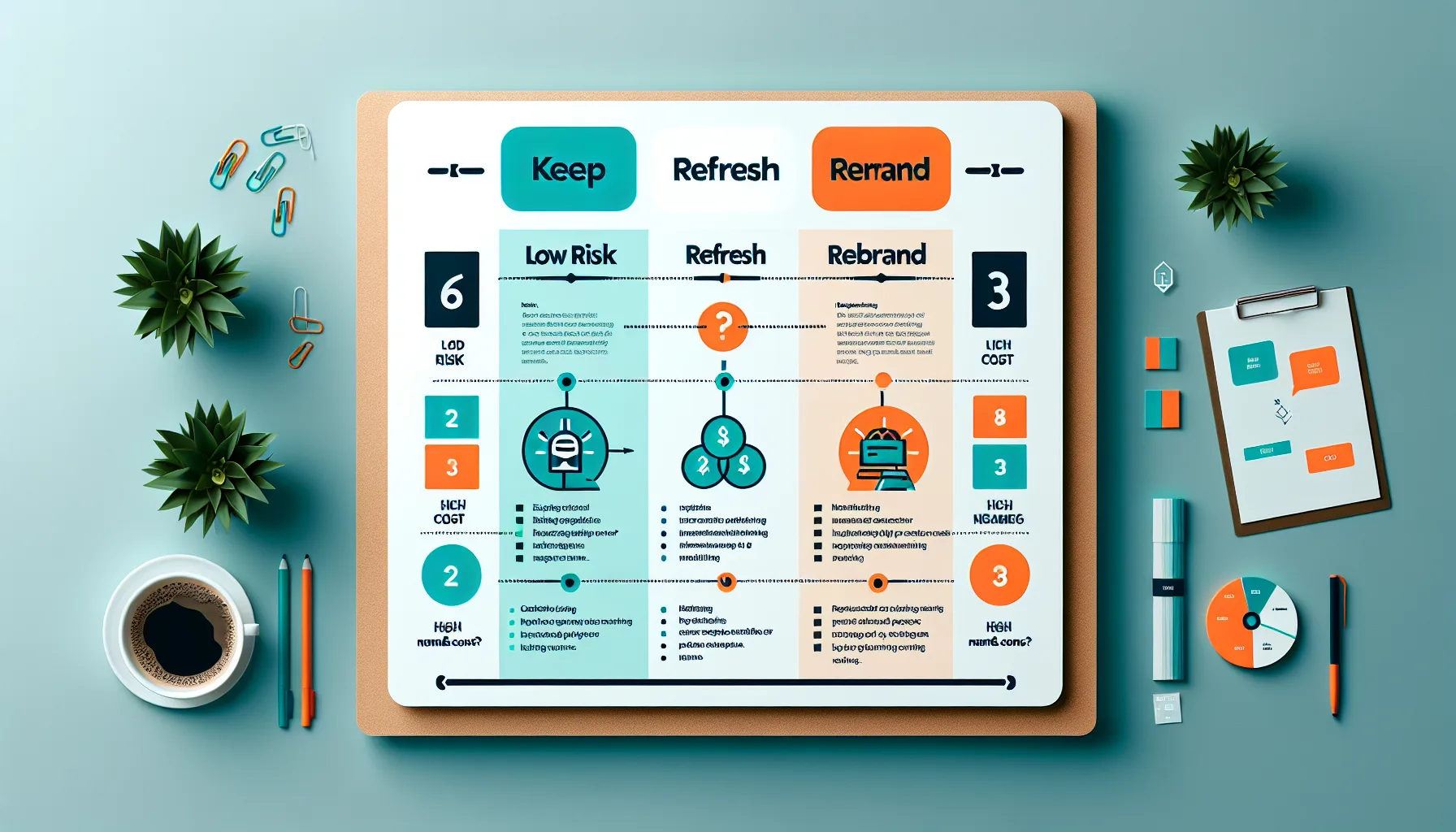
The Three Paths: Keep, Refresh, or Rebrand
You’ve got three options. Here’s what each one actually looks like in practice, with real costs.
Path 1: Keep Everything
Same name. Same logo. Same colors. Same website. Add “under new ownership” to your marketing for 6–12 months.
Cost: $500–$2,000 (yard signs, a few social media graphics, letterhead updates)
Timeline: Immediate
Best when:
- Google rating is 4.0+ with 50+ reviews
- The brand is well-known in the service area
- Employees are staying on and customers trust them
- You’re a first-time buyer and have enough to figure out already
This is the “don’t fix what isn’t broken” path. It’s boring. It works.
Path 2: Refresh
Same name, updated look. New logo, new colors, updated website, fresh truck wraps — but the name on the building stays the same.
Cost: $8,000–$25,000 depending on fleet size and website scope
Timeline: 60–120 days to fully roll out
Best when:
- The brand has equity but the visual identity looks dated
- You want to signal “same company, new energy” without confusing anyone
- The website is embarrassing or non-functional
- You’re planning to grow and the current brand won’t scale
A refresh is a solid middle ground. Customers still recognize the name. But everything looks a little sharper. It says “we’re investing in this” without saying “we’re a different company now.”
Path 3: Full Rebrand
New name. New logo. New website. New everything. Every truck gets rewrapped. Every yard sign gets replaced. The phone system gets a new greeting. You’re basically launching a new company with an existing customer list.
Cost: $25,000–$60,000+ depending on fleet size
Timeline: 90–180 days for full rollout
Best when:
- The brand is actively hurting you (bad reputation, legal issues)
- The previous owner’s personal name is the company name and they’re gone
- You’re consolidating multiple acquisitions under one brand
- The current name has zero meaningful brand equity
A full rebrand is expensive and risky. You will lose some organic search traffic. You will confuse some customers. Some of your repeat customers will see the new name on the truck and call the old number because they don’t realize it’s still you. Budget for 3–6 months of overlap marketing where you run both names.
The Decision Matrix
Ask yourself these four questions:
- Does the business have 100+ Google reviews above 4.0 stars? If yes, lean toward keeping the name.
- Do customers call asking for the previous owner by name? If yes constantly, consider a rebrand.
- Would you be proud to put the current brand on a new truck? If no, refresh at minimum.
- Is your 3-year plan to acquire more businesses in this market? If yes, think about what brand you want to scale.
Most of the time, the answer is Path 1 or Path 2. I’ve seen too many new owners burn cash on a rebrand they didn’t need because they wanted to “make it theirs.” Your ego is not a marketing strategy.
The Ownership Announcement Playbook
How you announce the change matters. Do it wrong and you’ll spend months cleaning up the confusion. Do it right and you actually build goodwill.
The Customer Letter
Send a letter — physical mail, not just email — to every customer in the database within two weeks of closing. Keep it to one page. Here’s the framework:
- Who you are (one sentence — background, why you’re qualified)
- What happened (the business was sold, you’re the new owner)
- What’s NOT changing (same team, same service area, same phone number, same commitment to quality)
- One improvement you’re making (extended hours, online scheduling, faster response times — pick one thing you can actually deliver)
- Your personal contact info (give them your cell phone or direct email — this builds trust fast)
What NOT to say: “Exciting changes ahead!” Customers hear that and think: price increases, new techs who don’t know my system, and hold music.
Google Business Profile Update
Do this on Day 1. Not Day 2. Day 1.
Log in, update the business description, verify your ownership information, and post an update. If you can’t access the profile on Day 1, it should have been handled in the purchase agreement. (More on this in the next section.)
Social Media Announcement
Post on every active social media account before someone in the community does it for you. Small towns talk. The HVAC community talks. If your acquisition shows up on a local Facebook group as a rumor before you’ve announced it, you’re playing defense instead of offense.
Keep the post simple. Photo of you (ideally with the existing team). Short message about continuity and commitment. Pin it to the top of the page.
Vendor and Supplier Notification
Call your top 10 suppliers and your equipment distributors personally. These relationships matter. Your Carrier or Trane rep can be a huge source of referrals and co-op marketing dollars. Introduce yourself. Ask about existing co-op agreements. Don’t let these relationships go cold during the transition.
Your Google Business Profile Is Worth More Than Your Website
I’m going to say something that most digital marketing agencies won’t tell you because they make money building websites: your Google Business Profile is the single most valuable marketing asset in this acquisition.
For a residential HVAC company, 60–80% of new customer calls come from Google. Most of those come from the local map pack — the three businesses that show up with the map when someone searches “AC repair near me.” That listing is powered by your Google Business Profile.

Do NOT Create a New Profile
I cannot emphasize this enough. If the business has an existing Google Business Profile with reviews, you claim that profile. You transfer it. You update it. You do NOT create a new one.
Reviews do not transfer between profiles. If the business has 200 reviews at 4.7 stars, and you create a new profile, you start at zero reviews. That is not a rounding error. For a residential HVAC company, going from 200 reviews to zero is roughly equivalent to losing $150,000–$250,000 in annual marketing value.
How to Handle the Transfer
The ideal scenario: ownership transfer of the Google Business Profile is written into your purchase agreement. The seller transfers admin access at closing, and you remove their access after you’ve verified everything.
If the previous owner controlled the profile through their personal Google account (common with small businesses), you need them to:
- Add your Google account as an owner of the profile
- Wait for you to accept the invitation
- You then make yourself the primary owner
- Remove their access
Get this done before the seller disappears into retirement. I’ve seen buyers spend months trying to claim profiles through Google’s recovery process. It’s painful.
The First 90 Days of Review Management
For the first three months, you personally respond to every single Google review — good and bad. Not your office manager. Not a template. You.
For positive reviews: thank them by name, mention something specific about the job, and sign it as the new owner.
For negative reviews: respond professionally, acknowledge the issue, and offer to make it right. If the negative review is from before your ownership, it’s fine to say: “I recently acquired this business and I’m committed to addressing exactly this kind of issue. Please call me directly at [number] so I can make this right.”
That response isn’t just for the reviewer. It’s for the 50 potential customers who are going to read that review before they call you.
The 90-Day Marketing Calendar for New HVAC Owners
Forget the marketing plan you sketched on a napkin during due diligence. Here’s what actually needs to happen, in order. (For the full operational transition beyond marketing, see Your First 90 Days as the New HVAC Owner.)
Days 1–30: Secure
This phase is about locking down every marketing asset and making sure nothing breaks.
- Claim all online profiles: Google Business Profile, Yelp, BBB, Angi, HomeAdvisor, Facebook, Instagram, NextDoor — whatever the business has
- Get every password: Website hosting, domain registrar, email accounts, social media, CRM, review platforms, advertising accounts
- Secure the customer database: Export the full customer list with contact info, service history, and equipment records. Put it somewhere you control.
- Audit active advertising: Is the previous owner running Google Ads? Facebook ads? LSA (Local Services Ads)? Yellow Pages? Find out what’s running, what it’s costing, and what’s producing calls.
- Update the phone tree: If the previous owner’s voice is on the hold message or the voicemail, change it.
The goal of Month 1 is zero surprises. No customer should call and get a disconnected number. No online listing should have wrong information. No ad should be running without your knowledge.
Days 31–60: Stabilize
Now you build on the foundation.
- Website updates: At minimum, update the “About” page, contact information, and team photos. If the site is WordPress, make sure plugins are updated and it’s not a security risk.
- Service agreement outreach: Pull the list of every customer with an active maintenance agreement. Send them a personal letter or email confirming their agreement is honored and introducing yourself. These are your most valuable customers. Treat them like it.
- Review generation system: Set up an automated process (or a manual one — whatever you can sustain) to ask every completed job for a Google review. Text message follow-ups convert at 3–5x the rate of email.
- Local visibility: Join the local chamber of commerce. Sponsor a Little League team. Show up at a Rotary meeting. In residential HVAC, community presence still drives business.
- Referral conversations: Talk to your best customers and ask who else they’d recommend your services to. Talk to your real estate agent contacts. Talk to property managers. Relationships are the cheapest marketing channel you have.
Days 61–90: Grow
Now — and only now — do you start spending real marketing money.
- Launch or optimize Google Local Services Ads (LSAs). These are the “Google Guaranteed” ads at the very top of search results. For HVAC, they’re typically the highest-converting paid channel. Budget $1,500–$3,000/month to start.
- Set up a referral program. Offer existing customers $50–$100 for every referral that converts. Simple, trackable, and effective.
- Seasonal campaign planning. If you’re reading this in spring, you should be planning your AC tune-up campaign. Fall? Furnace season. HVAC marketing is cyclical. Plan 60 days ahead.
- Direct mail to the service area. Old school? Yes. Dead? No. A well-designed postcard to 5,000 homes in your service area, timed with the season, still generates calls at $30–$50 per lead in most markets.
Budget Reality
Here’s what most HVAC marketing agencies won’t tell you upfront: to grow an acquired HVAC business aggressively, budget 8–12% of your target revenue on marketing.
If the business did $1.5M last year and you want to grow it to $2M, your marketing budget should be $160,000–$240,000 for the year. That includes everything: LSAs, Google Ads, direct mail, truck wraps, sponsorships, website maintenance, and the CRM software that tracks it all.
If that number makes you swallow hard, here’s the good news: you don’t spend it all at once. Months 1–3, you’re spending maybe $2,000–$4,000/month on marketing while you stabilize. Months 4–12, you ramp up. The big spend comes after you’ve proven the operation can handle the volume.
The businesses I see struggle are the ones spending 2–3% on marketing and wondering why the phone isn’t ringing. You can’t out-service a marketing problem.
The Website Decision
Your website matters, but probably not as much as you think — and definitely not as much as a web design agency will tell you.
If the Current Site Is Decent
“Decent” means: it loads on a phone, it shows up on Google, and it has a phone number a customer can click to call. If the existing site does those three things, update it. Don’t rebuild it.
Updates to make in the first 60 days:
- New “About Us” page with your photo and story
- Updated contact information and service area
- Confirmation that you honor existing service agreements
- A simple contact form that goes to an email you actually check
That’s it. You don’t need a blog. You don’t need custom photography. You don’t need animations. You need a website that converts a Google searcher into a phone call. Everything else is a distraction for the first year.
If There Is No Website
Believe it or not, this is actually easier. You’re not inheriting someone else’s mess. You’re starting clean.
Get a simple, professional site built on WordPress or a similar platform. Five to seven pages. Budget $3,000–$7,000 for a good one. Make sure it has:
- Mobile-responsive design (60%+ of your traffic is from phones)
- Click-to-call buttons on every page
- Service area pages (one page per city/town you serve — this is huge for local SEO)
- Google indexing verified through Google Search Console
- Fast load speed (under 3 seconds — test it on a phone, not your office Wi-Fi)
If the Current Site Is Terrible
You know it when you see it. Built in 2012. Flash animations. A stock photo of a family that looks nothing like your customers. Contact form that emails a Yahoo address the previous owner hasn’t checked since Obama’s second term.
In this case, rebuild. But don’t let it become a three-month project. Get a functional site up in 30 days and improve it over time. A simple site that works beats a complex site that’s “almost done” for four months.
Skip for Now
These are all fine things to have eventually. They are not priorities in the first year:
- Blog content (unless you’re doing it yourself and enjoy writing)
- Custom video production
- Fancy booking portals
- SEO agencies with 12-month contracts
- Social media management services
Survive first. Optimize later.
Frequently Asked Questions
Should I tell customers the business was sold?
Yes. Proactively and honestly. Customers find out anyway — through the previous owner, through employees, through the local rumor mill. If they find out from someone other than you, you’ve already lost control of the narrative.
The announcement doesn’t need to be dramatic. A letter, a social media post, and a mention from your techs during service calls. Frame it as continuity: same great team, same great service, new ownership that’s investing in the future.
Trying to hide an ownership change is a losing strategy. People feel deceived when they find out, and they always find out.
How do I handle bad reviews from before I owned the business?
You own them now. That’s the deal. You bought the business, and the reviews — good and bad — came with it.
For bad reviews posted before your ownership:
- Respond publicly with a brief, professional note acknowledging the issue and stating that you’re the new owner committed to doing better
- Do NOT argue with the reviewer or make excuses about the previous ownership
- Do NOT try to get old reviews removed by flagging them as irrelevant — Google almost never removes legitimate reviews, and attempting to manipulate reviews can get your profile penalized
- Bury them with volume — the fastest way to push old bad reviews down is to generate a steady flow of new good ones
If the business has a genuinely terrible review history (below 3.5 stars), this factors into your rebrand decision. Sometimes a fresh Google profile is worth the tradeoff, but only in extreme cases.
When should I start advertising?
Not until you’ve completed the “Secure” phase (Days 1–30). Running ads to a business with incorrect phone numbers, broken websites, or unclaimed Google profiles is burning money.
The first paid advertising most new HVAC owners should invest in is Google Local Services Ads (LSAs). They’re pay-per-lead (not pay-per-click), they show at the very top of Google search results, and they include a “Google Guaranteed” badge that builds instant trust.
Start LSAs in Month 2 at a modest budget. Scale up in Month 3 and beyond as you prove you can handle the call volume and convert leads into booked jobs.
Google Ads (the regular pay-per-click kind) are a solid second channel, but they’re more complex to manage and easier to waste money on. If you’re going to run Google Ads, hire someone who specializes in home services PPC. General digital marketing agencies often lack the HVAC-specific knowledge to run efficient campaigns.
Do I need a marketing agency?
Not in the first 90 days. Maybe not in the first year.
Here’s the honest truth: most HVAC marketing agencies are set up to serve businesses that are already stable and growing. They want to run your Google Ads, manage your social media, and send your email campaigns. That’s fine — when you’re ready for it.
In the first 90 days, you need to:
- Secure your online profiles (you can do this yourself)
- Send an ownership announcement (you can do this yourself)
- Respond to reviews (you should do this yourself)
- Update your website (hire a freelancer for $500–$2,000)
- Launch LSAs (Google makes this fairly simple)
When you’re ready for an agency — typically 6–12 months in — look for one that specializes in home services or HVAC specifically. Ask for references from other HVAC business owners. Ask to see real performance data, not just pretty case studies.
A good HVAC marketing agency will pay for itself 3–5x over. A bad one will cost you $3,000–$5,000/month and generate reports that look impressive but don’t move the phone.
The Bottom Line
Marketing an acquired HVAC business is not the same as marketing a startup. You’re not building from zero. You’re protecting what exists and then strategically growing it.
Keep the name unless you have a concrete reason not to. Announce the transition honestly and early. Protect your Google Business Profile like it’s your most valuable asset — because for marketing purposes, it is. Follow the 90-day calendar. And resist the urge to spend money on marketing until you’ve secured the foundation.
The best marketing for a newly acquired HVAC business isn’t clever. It’s consistent, it’s local, and it starts with not breaking what you bought.
You’ll have plenty of time to make it yours. Earn that right first.