Heat-pump-capable HVAC businesses are selling for more money right now. Noticeably more. If you’re shopping for a company to buy, you need to decide: pay the premium for one that’s already there, or buy a gas-heavy shop and build the capability yourself. Here’s how to think about it.
Some HVAC Businesses Are Worth More Right Now. Here’s Why.
If you’ve been looking at HVAC businesses for sale in the last 12 months, you’ve probably noticed something weird. Two companies with nearly identical SDE — seller’s discretionary earnings, the number your lender actually cares about — are listing at very different prices.
The difference? Heat pumps.
Businesses with strong heat pump installation revenue are commanding 1-2x higher SDE multiples than gas-only shops. In real numbers, that looks like this:
- Gas-heavy business: $350K SDE × 3x multiple = $1.05M asking price
- Heat-pump-ready business: $350K SDE × 4-5x multiple = $1.4M-$1.75M asking price
That’s a $350K-$700K gap for two businesses throwing off the same cash. The seller isn’t crazy. Brokers aren’t making it up. The premium is real, and it’s being driven by where the industry is headed — not just where it is today.
The question isn’t whether the premium exists. It’s whether it’s worth paying, or whether you can close the gap yourself for less money.
Why Electrification Is Driving HVAC Valuations
This isn’t hype. There are specific, concrete reasons buyers (and their lenders) are treating heat-pump-ready businesses as more valuable. Here’s the short list.
The regulatory push
- California’s 2030 gas furnace ban for new construction. The largest HVAC market in the country is going all-electric for new builds within four years.
- New York’s 2026 all-electric requirement for new buildings under seven stories. Already in effect.
- Washington, Massachusetts, Colorado — all moving toward electrification mandates at various stages.
These aren’t proposals. They’re law. And where California goes, others follow. You know this.
The money push
- Federal IRA tax credits: Up to $2,000 per heat pump installation for homeowners, plus contractor-level incentives that vary by program.
- State utility rebates: Adding $1,000-$8,000 per installation depending on state, utility, and income qualification. Some states are stacking federal and state incentives so aggressively that a $18K heat pump system nets down to $10K for the homeowner.
- Rebates make the sale easier. Easier sales mean higher close rates. Higher close rates mean more revenue per lead.
The market reality
- Dual fuel systems — heat pump paired with a gas backup — give contractors a competitive edge. You can sell to every customer, not just the all-electric crowd.
- The installed base of gas furnaces is enormous. Every one of them is a future retrofit opportunity over the next 10-15 years.
- Heat pump installations carry higher average ticket sizes: $15K-$25K vs. $6K-$10K for a standard gas furnace swap. Same truck roll, bigger invoice.
The bottom line: Electrification isn’t coming. It’s here. The businesses positioned for it are worth more because they’ll generate more revenue per job in the markets that matter most.
What “Heat Pump Ready” Actually Means for an HVAC Business
Here’s where a lot of buyers get fooled. A company that installed a dozen mini-splits last year is not “heat pump ready.” That’s a company that dabbles.
The businesses commanding the real premium have built actual capability. Here’s what that looks like.
Revenue mix
30% or more of installation revenue coming from heat pump systems — full ducted heat pumps, ductless mini-splits, dual fuel setups. Not just the occasional one-off when a customer specifically asks for it.
If heat pump revenue is under 15%, the seller doesn’t get to charge you a heat pump premium. Don’t let them.
Certified technicians
Techs with manufacturer certifications for major heat pump lines — Mitsubishi, Daikin, Carrier/Bryant, Bosch. Not just EPA 608, which every tech has. Actual product-specific training on variable-speed compressors, refrigerant management for inverter-driven systems, and cold-climate performance tuning.
This matters because you can’t train overnight. Manufacturer certification programs take weeks per tech, and most require hands-on lab work — you can’t just watch YouTube videos. A business that already has 4-6 certified heat pump installers has a real head start that would take you 6-12 months to replicate even under ideal conditions.
I’ve seen buyers assume they can “figure out” heat pumps because their techs are good with gas equipment. Good techs are good techs, but a variable-speed inverter-driven heat pump has more in common with a computer than a furnace. The learning curve is real.
Design capability
Manual J and Manual S load calculations for heat pump sizing are genuinely harder than gas furnace sizing. Heat pumps are more sensitive to load calculations — oversize a gas furnace and you get short cycling, oversize a heat pump and you get poor dehumidification, terrible efficiency, and unhappy customers.
The business should have staff who can run load calcs confidently, not just plug numbers into a software tool and pray.
Supplier relationships
Wholesale accounts with heat-pump-focused distributors. Access to cold-climate units when they’re backordered everywhere else. Preferred pricing from manufacturers. These relationships take years to build and they directly affect margin.
Sales process
Selling a $20K heat pump system is a fundamentally different conversation than selling a $7K gas furnace. Different customer objections, different financing options, different rebate paperwork. A heat-pump-ready business has a proven sales process for this higher-ticket work.
Rebate navigation
Staff who know how to process IRA tax credits and state-level rebates for customers. This sounds administrative, but it’s a real competitive advantage. Contractors who handle the rebate paperwork close more deals than contractors who tell the customer “you can apply for that yourself.” With federal tax credits expired and state HEEHRA programs now running the show, state rebate registration as an acquisition asset is a due diligence dimension most buyers miss entirely.
The Math: Pay the Premium or Build It Yourself?
Let’s actually run the numbers. Two scenarios, same starting point: you’re looking at a market where heat pump demand is growing and you want to be positioned for it.
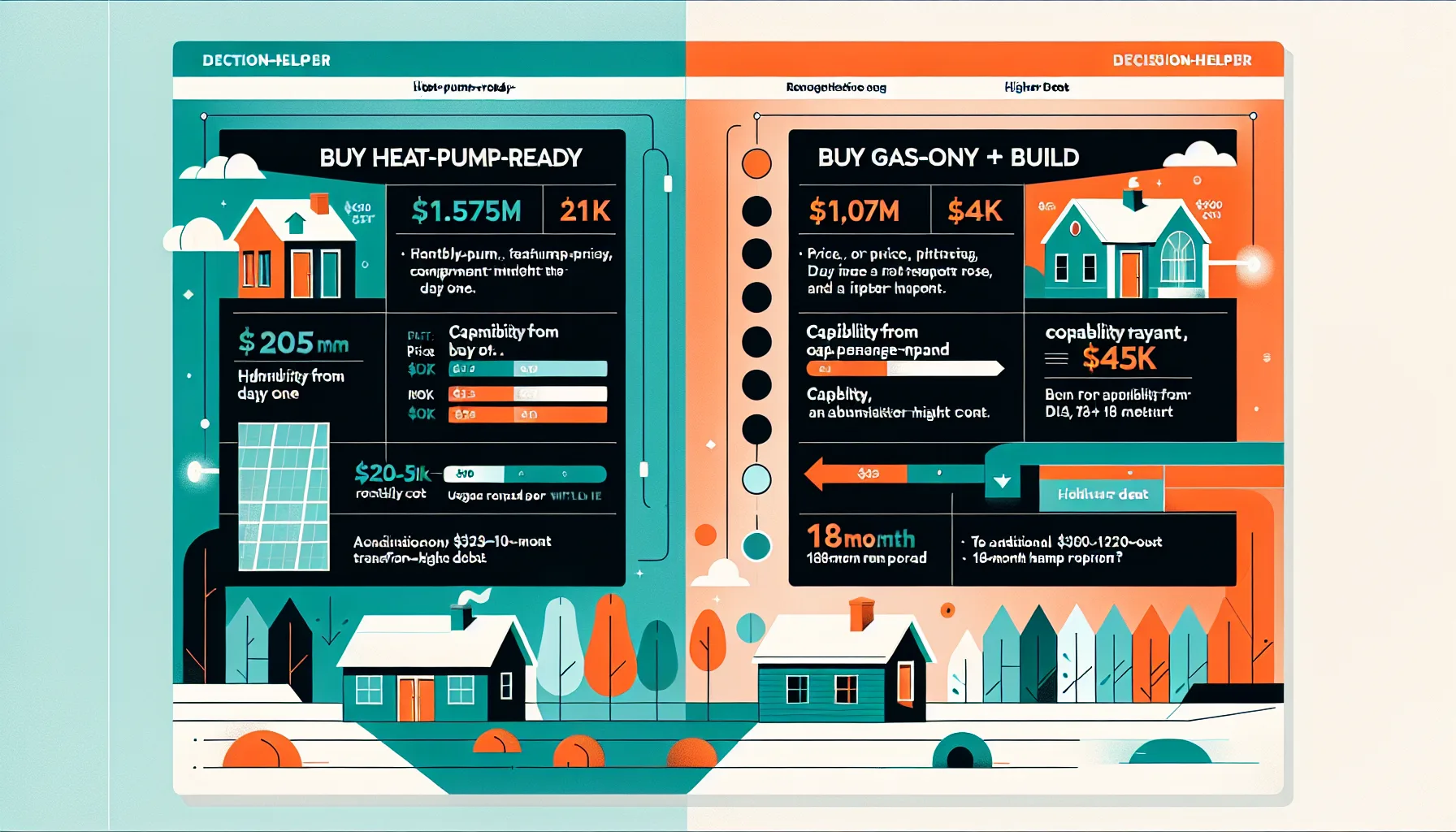
Scenario A: Buy a heat-pump-ready business
- SDE: $350K
- Multiple: 4.5x (middle of the heat pump premium range)
- Purchase price: $1.575M
- SBA loan payment (10.5% over 10 years): ~$21,000/month
- Heat pump revenue is already flowing. Techs are trained. Supplier relationships exist. Sales process is proven.
- You walk in on day one already generating heat pump revenue.
Scenario B: Buy a gas-only business and build heat pump capability
- SDE: $350K
- Multiple: 3x (standard for a solid gas-heavy shop)
- Purchase price: $1.05M
- SBA loan payment (10.5% over 10 years): ~$14,000/month
That’s $7K less per month in debt service. But now add the transition costs:
- Tech training: $3K-$5K per tech × 8 techs = $24K-$40K
- Inventory build: $50K-$100K for initial heat pump equipment stock
- Marketing repositioning: $10K-$20K to rebrand and generate heat pump leads
- Lost productivity: 12-18 months of reduced efficiency while techs get up to speed and the sales pipeline builds
Total transition cost: $100K-$175K over 18 months.
The comparison
| Scenario A (Buy Ready) | Scenario B (Build It) | |
|---|---|---|
| Purchase price | $1.575M | $1.05M |
| Transition costs | $0 | $100K-$175K |
| Total outlay | $1.575M | $1.15M-$1.225M |
| Monthly debt service | $21K | $14K |
| Heat pump revenue | Day 1 | Month 12-18 |
| Execution risk | Low | Moderate-High |
Net savings with Scenario B: $350K-$425K upfront. That’s real money. But you’re also eating 12-18 months of delayed heat pump revenue and taking on execution risk — what if your techs struggle with the transition? What if your market shifts faster than you planned?
The verdict: Neither is automatically better. Scenario A makes sense in markets where heat pump demand is strong right now and growing fast — you can’t afford to spend 18 months building capability while competitors are already closing $20K jobs. Scenario B makes sense in markets where adoption is still early and you have time to build without losing ground.
Your ability to recruit and train heat pump techs is the single biggest variable. If you can hire two experienced heat pump installers from a competitor on day one, Scenario B gets a lot more attractive. If the local talent pool is thin and everyone’s fighting over the same techs, Scenario A starts looking like cheap insurance.
Either way, these numbers should feed into your acquisition math before you make an offer.
How to Evaluate Heat Pump Readiness in Due Diligence
Whether you’re paying the premium or not, you need to know exactly what you’re getting. Here’s the checklist.
- Request revenue breakdown by system type. Gas furnace, central AC, heat pump, dual fuel, mini-split — each as a separate line item. If the seller lumps “heating and cooling installations” into one number, push back. You need granularity.
- Get the trend line. Heat pump revenue as a percentage of total installation revenue, by year, for the last three years. You want to see growth. Flat or declining means the business dabbles but isn’t committed.
- Review technician certifications. Actual certificates, not “oh yeah, my guys can do heat pumps.” Who’s certified on which brands? When did they complete training? Are certifications current?
- Check manufacturer relationships. Are they an authorized dealer for major heat pump lines? Authorized dealers get better pricing, priority access to equipment, and co-op marketing dollars. Non-authorized installers are buying at retail markup.
- Ask for sample proposals. Pull 5-10 recent heat pump job proposals. What’s the average ticket size? What’s the close rate compared to gas furnace proposals? How are they presenting the rebate/incentive story?
- Review marketing materials. Does the website feature heat pump installations? Do Google Ads target heat pump keywords? Is there a dedicated landing page? A business that doesn’t actively market heat pumps isn’t serious about them.
- Check rebate processing history. How many IRA credits or state rebates have they processed for customers in the last 12 months? Zero is a red flag. Twenty-plus is a sign they’ve built the administrative muscle.
- Evaluate geographic factors. What are the local and state electrification mandates? What utility incentive programs exist? What’s the competitive landscape — are other local HVAC companies already positioning for heat pumps?
This checklist overlaps with your broader due diligence work — heat pump readiness is just one more dimension to evaluate.
The Markets Where the Premium Makes Sense (And Where It Doesn’t)
Geography matters enormously here. The heat pump premium isn’t universal — it’s market-specific.

Premium justified
- California — 2030 gas furnace ban for new construction. Aggressive state rebates. Massive market. If you’re buying in California and the business isn’t heat-pump-ready, you’re buying a depreciating asset.
- New York — All-electric requirement already live for new buildings. Dense retrofit market. Strong utility incentives.
- Washington, Massachusetts, Colorado — Active electrification mandates at various stages. Growing heat pump adoption. Utility programs pushing hard.
In these states, paying 4-5x SDE for a heat-pump-ready business is defensible. The regulatory tailwind is real and it’s not going away.
Premium questionable
- Texas — Huge AC market, but gas is cheap and plentiful. No state electrification mandate. Heat pumps are growing, but slowly. Pay the standard multiple and build capability at your own pace.
- Florida — Similar story. Strong cooling demand makes heat pumps logical, but no regulatory push. The economics work in some segments but there’s no urgency premium.
- Arizona — Gas isn’t dominant for heating anyway (it’s 110 degrees), but the electrification mandate pressure is minimal. Heat pumps are already common for cooling, which muddies the “premium” story.
Wild card markets
- Minnesota, Wisconsin, Maine — Cold-climate heat pumps have gotten dramatically better. The Mitsubishi Hyper-Heat and similar units work down to -13°F now. Adoption is early, but the first contractor in a cold-climate market who can confidently sell and install cold-climate heat pumps owns that market for years.
- First-mover advantage is real here. But so is the risk of being too early.
Don’t ignore local utility programs
Some utilities are aggressively pushing heat pump adoption with contractor-specific incentives — bonus payments per installation, co-op marketing funds, preferred contractor listings — regardless of state-level mandates.
I know a guy in Ohio — no state electrification mandate whatsoever — whose utility pays him a $500 bonus per heat pump installation and lists him as a “preferred contractor” on their website. He gets 3-4 inbound leads per week from that listing alone. Meanwhile his competitor across town doesn’t even know the program exists.
Check what your local utility offers before assuming your market isn’t ready. Call the utility’s commercial programs department. Ask specifically about contractor incentives for heat pump installations. You might be surprised.
The Risk Nobody Mentions: What If the Transition Stalls?
Every premium is a bet on the future. The heat pump premium is a bet that electrification continues accelerating. But what if it doesn’t?
The realistic risk factors
- Regulatory rollbacks. Political winds shift. A new governor or legislature could delay or weaken electrification mandates. It’s happened before with energy policy.
- Grid capacity. The electrical grid in many regions is already strained. Mass electrification of heating adds enormous load. If utilities can’t keep up, the push slows down.
- Consumer cost resistance. A $20K heat pump system is a hard sell when a $7K gas furnace does the job in a state with $2/therm gas. Rebates help, but they don’t eliminate the sticker shock — especially now that the Section 25C federal credit has expired. Read more about how the Section 25C expiration changes heat pump revenue projections.
- Natural gas prices. If gas stays cheap — and U.S. production suggests it will for a while — the economic argument for switching weakens in non-mandate states.
What holds value regardless
Here’s the thing. The businesses that hold their value through any market shift aren’t the ones riding a single trend. They’re the ones with:
- Strong maintenance agreement books. Recurring revenue is recurring revenue, gas or electric.
- Diversified service revenue. Companies that do installs, repairs, maintenance, and commercial work across multiple system types.
- Good technicians who stay. A team of experienced, loyal techs is the hardest thing to build in HVAC. It’s worth more than any heat pump certification.
Heat pump capability is a genuine value-add. But it’s a bonus on top of a solid business — not a substitute for one.
Don’t overpay for a trend. Pay for a good business that happens to be positioned well.
Frequently Asked Questions
Is every HVAC business going to need heat pump capability eventually?
Probably yes. But “eventually” could mean five years in California or fifteen years in Alabama. The pace varies dramatically by market. The smart move is to start building capability now regardless — even if your market isn’t mandating it yet, the customer demand is growing and the federal incentives are there.
Can I add heat pump capability without retraining my whole team?
Yes, and you should start small. Pick 2-3 of your strongest techs and send them through manufacturer certification programs. Build a dedicated heat pump installation crew rather than trying to cross-train everyone at once. Your gas furnace techs keep generating revenue while the heat pump team ramps up.
What if I’m in a state with no electrification mandate?
Mandates aren’t the only driver. The IRA tax credits are federal — they work in every state. Many homeowners are choosing heat pumps for efficiency and comfort regardless of mandates. And dual fuel systems (heat pump + gas backup) are an easy sell even in gas-friendly markets because they optimize energy costs year-round.
Should I walk away from a gas-only business?
No. Absolutely not. A well-run gas-heavy HVAC business is still a great acquisition. The fundamentals haven’t changed — people need heating and cooling, equipment breaks, maintenance contracts print money. Just price it as what it is — a gas-focused business at a 2.5-3.5x multiple — and budget $100K-$175K and 12-18 months for the heat pump transition.
The installed base of gas systems generates service revenue for decades. Every gas furnace you service today is a future heat pump conversion lead. Gas isn’t disappearing. It’s just not the growth story anymore. And growth story or not, a business that throws off $350K in SDE from gas work pays your mortgage just fine.
How do I know if a seller is inflating the “heat pump premium”?
Look at the revenue mix. If heat pump installations are under 20% of total revenue, the seller doesn’t get to claim a heat pump premium. Ask for three years of revenue breakdown by system type. If it’s growing, the premium has some justification. If it’s flat or declining, they’re trying to sell you a story, not a capability.
The heat pump transition is real, but it’s not a gold rush — it’s a market shift that rewards businesses built on fundamentals. Whether you pay the premium or build the capability yourself, the goal is the same: own a company that can serve every customer who walks through the door, regardless of what’s powering their system.