

You found the right HVAC company, negotiated a fair price, and signed the closing docs. Then you discovered you can’t legally pull a permit. Here’s how to make sure that doesn’t happen to you.
The Deal Was Done. Then the License Wasn’t.
Here’s a story I’ve heard three versions of.
A buyer closes on a $1.1M HVAC business in Florida. Good SDE, solid customer base, clean financials. The previous owner hands over the keys, shakes hands, and drives off into retirement. Three weeks later, the buyer walks into the county building department to pull a permit on a $38,000 commercial install.
The clerk looks at the screen and says, “This contractor license is inactive.”
The license was tied to the previous owner’s personal qualification. When he left, the license left with him. The business entity still existed. The trucks still had the logo. But legally, the company could not perform installation or replacement work until a new qualifying individual was on file with the state.
The state application process? Ninety days. Minimum.
That’s 90 days where a fully staffed HVAC company with $1.4M in annual revenue can only do maintenance and repair work — no installs, no replacements, no new construction. The buyer estimated the revenue loss at $180,000.
This happens more often than you’d think. And it’s 100% preventable — if you know what to look for before you close.
How HVAC Licensing Actually Works (The Acquisition Version)
Most buyers understand that HVAC contractors need licenses. What they don’t understand is that there are three different things people call “the license,” and they work completely differently in an acquisition.
Business License
This is the general operating license from your city or county. It says you’re a business that exists at this address and pays taxes. In an entity purchase (buying the LLC or corporation), it usually transfers. You file a name/officer change and move on.
Not the problem.
Contractor License
This is the one that lets you pull permits and perform regulated HVAC work — installations, replacements, major repairs. In most states, this license is issued to a person, not to a company. The company operates under that person’s qualification.
This is the problem.
Qualifying Individual License
The qualifying individual (sometimes called the “qualifier” or “designated licensee”) is the person whose credentials allow the business to operate as an HVAC contractor. In many states, this is the owner. When the owner sells and leaves, the qualification goes with them.
The business doesn’t lose its name or its trucks or its customer list. It loses its legal authority to do permitted work. And nobody at the closing table will tell you this unless you ask.
The critical distinction: The business license follows the entity. The contractor license follows the person. If those are the same person who’s leaving, you have a gap.
The Three Acquisition Scenarios
How this plays out depends entirely on how you structure the purchase.
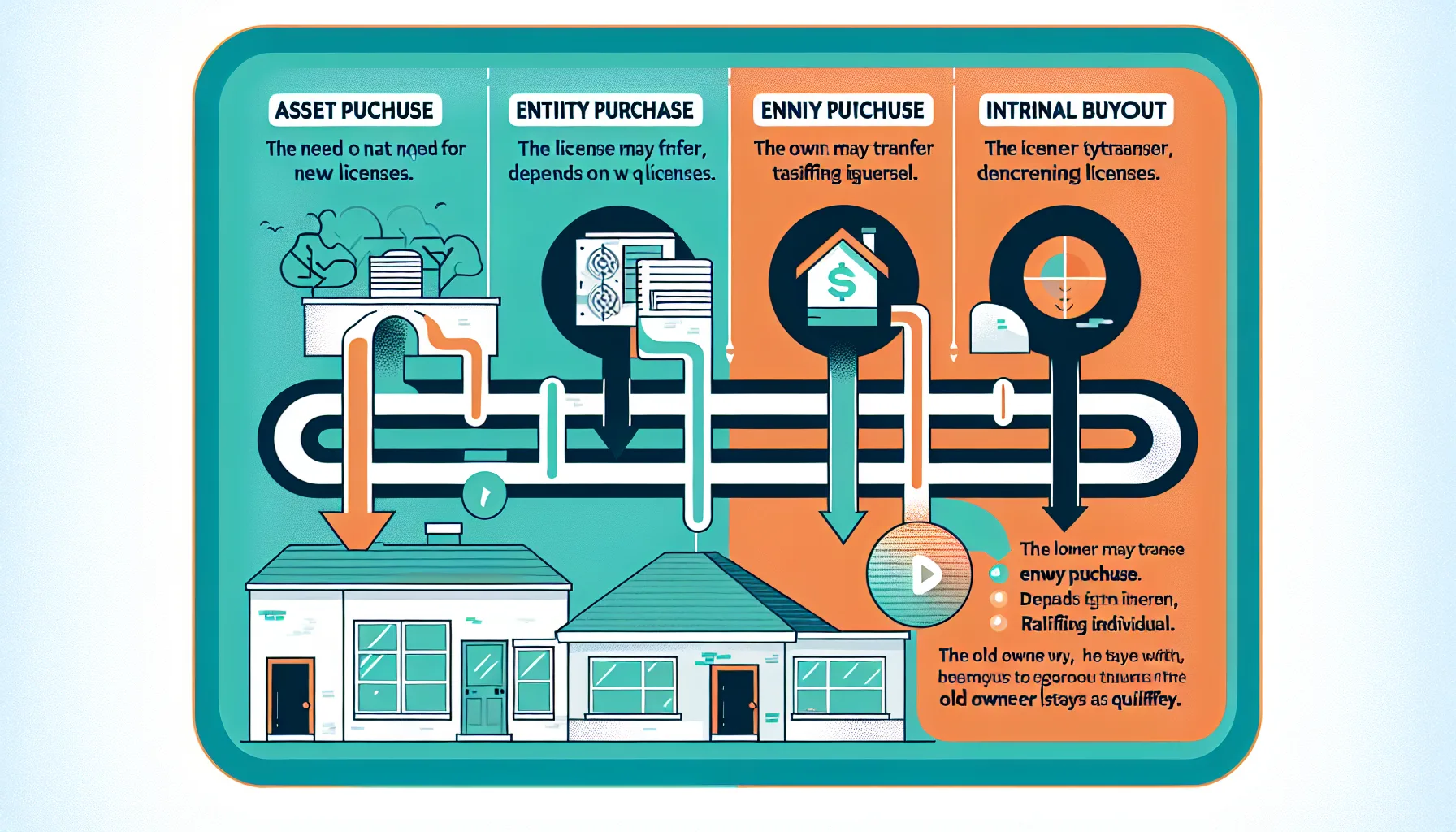
Asset Purchase
You’re buying the customer list, the equipment, the brand, the phone number — but not the legal entity. You are starting a new business that happens to have the old business’s stuff.
You need every license from scratch. State contractor license, county occupational license, city business tax receipt, all of it. There is no transfer. There is no shortcut.
Timeline impact: If you don’t already hold a contractor license, you need to start the application process months before closing. Some states require experience documentation, exams, and background checks that take 4–6 months to process.
Entity Purchase
You’re buying the LLC or corporation itself. The legal entity continues to exist — you’re just the new owner.
The business license typically carries over with an officer change filing. But the contractor license? That depends entirely on your state. If the contractor license was issued to the business entity with a qualifying individual on file, you may be able to substitute a new qualifier. If it was issued to the owner personally, it doesn’t transfer regardless of the deal structure.
The trap: Buyers assume that buying the entity means buying the licenses. In roughly half the states, that’s not how it works for contractor licenses.
Internal Buyout
The previous owner agrees to stay on as the qualifying individual for a transition period — typically 30 to 90 days — while you obtain your own qualification or hire someone who has one.
This is the cleanest path. But it only works if it’s written into the purchase agreement. A handshake promise to “stay on and help out” means nothing when the former owner gets a job offer in another state two weeks after closing.
The State-by-State Patchwork
There is no federal HVAC contractor license. Every state does it differently. Some states don’t even require a state-level HVAC license — they push it to the county or city level, which makes it even more confusing.
Here’s what you’re dealing with.

States Where the License Is Personal
In Florida, Texas, California, Arizona, Georgia, North Carolina, and many others, the contractor license is tied to a qualifying individual. When that person is no longer associated with the business, the license is void or suspended until a new qualifier is approved.
- Florida: Requires a new qualifying agent application. Exam required if you don’t already hold a state certification. Processing time: 60–90 days.
- Texas: HVAC licenses are issued through TDLR to individuals. The business registers with the state but operates under the individual’s license. New owner needs their own license or a licensed employee on staff.
- California: CSLB contractor license requires a Responsible Managing Employee (RME) or Responsible Managing Officer (RMO). If the RMO was the departing owner, you have 90 days to replace them before the license is suspended.
States with Business-Level Licensing
A handful of states issue contractor licenses to the business entity rather than an individual. Even in these states, a change of ownership typically triggers a notification requirement, and the board may require re-qualification of the new owner.
Don’t assume “business-level” means automatic transfer. It means the paperwork is different, not nonexistent.
Reciprocity: Almost None
If you hold a license in one state and you’re buying a business in another, don’t count on reciprocity to save you.
- Texas has limited reciprocity agreements with South Carolina and Georgia.
- California has reciprocity with Arizona, Louisiana, and Nevada — but only for certain license classifications.
- New York has zero reciprocity with any state.
- Florida offers no reciprocity for HVAC contractor licenses.
The vast majority of state pairings have no reciprocity at all. You’re starting from scratch.
The Only Rule That’s Universal
Check your specific state’s contractor licensing board at least six months before your planned closing date. Not three months. Not “during due diligence.” Six months. Because if you discover a problem at month three, you may not have enough runway to fix it before closing.
EPA Section 608 — The Federal Layer
State licensing is the big trap, but there’s a federal layer that catches people too.
EPA Section 608 of the Clean Air Act requires certification for anyone who maintains, services, repairs, or disposes of equipment that uses regulated refrigerants. This is separate from your state contractor license. It’s federal. It applies everywhere.
The Four Certification Types
- Type I: Small appliances (under 5 lbs of refrigerant). Window units, PTACs, some mini-splits.
- Type II: High-pressure systems. This covers most residential and commercial A/C and heat pump equipment.
- Type III: Low-pressure systems. Centrifugal chillers, mainly commercial.
- Universal: All of the above. This is what most HVAC professionals hold.
What This Means for Buyers
If you’re going to be doing any hands-on work — and plenty of owner-operators do — you need your own EPA 608 certification. It’s not transferable from the previous owner. It’s not covered by the business purchase.
Every technician on staff needs their own certification too. During due diligence, verify that every tech has a current, valid EPA 608 card. If they don’t, that’s a compliance liability you’re inheriting.
The good news: EPA 608 certification doesn’t expire and the exam is widely available. You can get certified through an EPA-approved testing organization in a day. The bad news: if the previous owner’s technicians were working without proper certification, you could be inheriting violation liability.
Fines start at $44,539 per day per violation. That’s not a typo. Per day. Per violation.
How to License-Proof Your Deal
This is the checklist I wish I’d had. Print it out. Tape it to your wall. Don’t skip steps.
- Inventory every license the business currently holds. State contractor license, county occupational licenses, city business tax receipts, EPA Section 608 certifications for all personnel, any specialty certifications (gas fitting, refrigeration, electrical sub-licenses). Get the actual documents, not the seller’s word.
- Determine which licenses are tied to the entity vs. the qualifying individual. Call the state licensing board directly. Don’t rely on the seller’s understanding. Don’t rely on your attorney’s understanding unless they’ve specifically handled HVAC acquisitions in your state.
- Check your state’s contractor license transfer or re-qualification process. How long does it take? What are the requirements? Is there an exam? Do you need documented experience hours? What’s the application fee?
- Apply for your own license as early as legally possible. Many states allow you to begin the application process before closing. Some even allow you to hold a license without an active business, letting you “activate” it when the deal closes. Start early. There is no downside.
- Negotiate a qualifying individual transition period in the purchase agreement. This is non-negotiable. The previous owner or a licensed employee must remain as the qualifying individual until your own license or new qualifier is approved. Put a specific timeframe on it — 90 days minimum — and tie a portion of the purchase price to compliance.
- Budget for the gap. Even with the best planning, there might be a 30–60 day window where your licensing situation is in transition. Plan for it: qualifying individual on payroll, subcontracting arrangements for permitted work, or limiting operations to service and maintenance only. Know the revenue impact and factor it into your cash flow projections.
- Get insurance confirmation for the transition period. Your general liability and workers’ comp coverage must be valid during the ownership transition. Some carriers have specific requirements around licensing changes. Confirm in writing before closing.
This licensing checklist should be a core part of your broader deal evaluation process — a license gap is one of the most common preventable deal killers.
What to Put in the Purchase Agreement
Your attorney will draft the purchase agreement. Make sure these four items are in it. If your attorney pushes back, get an attorney who’s done contractor acquisitions before.
License Transfer Cooperation Clause
The seller agrees to cooperate fully with all license transfer, re-qualification, and application processes. This includes signing forms, providing documentation, appearing for interviews if required by the licensing board, and not taking any action that would jeopardize existing licenses during the transition period.
Qualifying Individual Transition Commitment
The seller (or a designated licensed employee) commits to serving as the qualifying individual for a specified period post-close — typically 30 to 90 days. Compensation for this period should be agreed upon in advance. This is not a favor. It’s a deal term. Pay for it.
Representations About Current License Status
The seller represents and warrants that all licenses are current, in good standing, free of pending complaints or investigations, and that they have disclosed all licensing requirements applicable to the business. If something surfaces after closing that they knew about, this gives you a legal remedy.
Remedies If License Transfer Fails or Is Delayed
What happens if the state takes longer than expected? What if your application is denied? Build in specific remedies: extended qualifying individual commitment, purchase price reduction, escrow holdback, or — in the worst case — a walk-away provision if the license gap exceeds a defined period.
Frequently Asked Questions
Can I operate under the previous owner’s license after I buy the business?
It depends on the state and the deal structure. In an entity purchase in some states, the existing license may remain active during a transition period while you substitute a new qualifying individual. In an asset purchase, no — you’re a new business and need your own license. In either case, you should not assume continuity. Verify with the state licensing board before closing.
How long does it take to get an HVAC contractor license?
It varies wildly by state. Some states can process an application in 30 days if you already meet all qualifications. Others take 6 months or more, especially if an exam is required. Florida averages 60–90 days. Texas can be faster if you already hold the required certifications. California’s CSLB process typically takes 90 days. Start early.
What if I already have my EPA 608 certification but not a state contractor license?
EPA 608 and your state contractor license are completely separate. The EPA certification lets you handle refrigerants legally. The state contractor license lets you operate as an HVAC contractor, pull permits, and do regulated work. You need both. Having one doesn’t help you get the other faster.
Do I need a separate license for each county or city?
Often, yes. Many jurisdictions require a local business license or occupational license in addition to your state contractor license. Some counties require a local competency exam. Some cities require additional registration even if you hold the state and county licenses. During due diligence, get a complete list of every jurisdiction where the business currently operates and verify the local requirements for each one.
What happens if there’s a licensing gap after I close?
You cannot legally perform work that requires a contractor license. Period. You can’t pull permits, you can’t do installations or replacements, and in some jurisdictions you can’t even advertise those services. You can typically continue performing maintenance and repair work that doesn’t require permits, but that’s a fraction of most HVAC companies’ revenue. The financial impact of a 90-day gap on a business doing $1.5M annually could easily exceed $200,000 in lost revenue.
The Bottom Line
Licensing is not a closing formality. It’s a structural element of the deal — as important as the financials, the customer contracts, and the fleet condition. A $200 license application that you filed six months early costs you nothing. A licensing gap you discover three weeks after closing costs you everything.
Do the homework. Make the calls. File the applications. Put it in the purchase agreement.
The best HVAC acquisitions are boring. Everything transfers cleanly, the licenses are in order, and nobody has to scramble. That’s what you’re aiming for. The exciting version — where you’re on the phone with the state licensing board at 8 AM trying to figure out why you can’t pull a permit on a job you already sold — is the version you want to avoid.
I’ve seen deals worth seven figures nearly collapse over a piece of paper that costs less than a service call. Don’t be that buyer.
This article covers licensing risks in HVAC acquisitions. For the complete due diligence picture, read Chapter 4: Due Diligence. For other common deal killers, see HVAC Red Flags: 12 Things That Kill Deals. And for the operational side of what happens after closing, check out Your First 90 Days as the New HVAC Owner.