

A listing says $1.2 million. Your stomach drops. But that number is just the opening line of a math problem — and the answer determines whether you're buying a business or buying yourself a second job.
You're on BizBuySell or you got a call from a broker. There's an HVAC company listed at $1.2 million. Good service area, solid reputation, 14 employees. And your first thought is: where in the world do I get $1.2 million?
That's the wrong question. The right question is: does the math work?
The asking price isn't what you pay out of pocket. It's not what you'll owe monthly. It's just a number derived from another number, multiplied by a third number, and then rounded up because the seller's broker told them they deserved it.
This article walks through every layer of that math. By the end, you'll be able to look at any HVAC listing and know — in about 15 minutes — whether it's worth a phone call or a hard pass.
The Listing Says $1.2 Million. What Does That Actually Mean?
A business listed at $1.2M is not asking you to write a $1.2M check. What it's really saying is: "The seller's discretionary earnings (SDE) multiplied by some number equals $1.2M."
SDE is the total financial benefit of owning this business. It's net profit plus the owner's salary, plus any personal expenses the current owner runs through the company — the truck, the phone, the health insurance, the "business trip" to Destin. It answers one question: how much cash does this business generate for whoever owns it? (If you need a deeper primer on SDE and other financial fundamentals, start with our Financial Literacy Crash Course.)
So if SDE is $340K and the asking price is $1.2M, the implied multiple is 3.5x.
$340,000 x 3.5 = $1,190,000 (rounded up to $1.2M because nobody lists a business at $1,190,000).
That multiple — 3.5x — is the real number you need to interrogate. It's the seller's claim about what their business is worth relative to its earnings. Sometimes that claim is reasonable. Sometimes it's aspirational. Sometimes it's laughable.
The asking price is the starting point. The math below tells you whether it's a good deal, a stretch, or a walk-away. And once you know your number, see our guide to the five negotiation levers that turn that math into a counteroffer.
SDE Multiples in 2026 — What Buyers Are Actually Paying
Multiples are not fixed. They shift with interest rates, buyer demand, and how much private equity money is sloshing around the HVAC space. Here's where the market sits in 2026.
By revenue size
- Under $1M revenue: 2.75x–3.25x SDE. These are one-truck-to-three-truck operations. Buyer pool is mostly technicians buying their first company. Less competition, more negotiating room.
- $1M–$5M revenue: 3.25x–4.0x SDE. The sweet spot for acquisition. Big enough to have real infrastructure, small enough that PE firms aren't aggressively bidding. Most SBA-financed HVAC deals land here.
- Over $5M revenue: 4.0x and up. Once you cross this threshold, you're competing with platform companies and roll-up strategies. Multiples get stretched. If you're a first-time buyer, this is probably not your arena.
For a deeper look at how valuation methods work in HVAC specifically, see our Chapter 3: HVAC Business Valuation.
The maintenance agreement premium
This is the single biggest factor that separates a 2.75x business from a 4.0x business at the same revenue level.
A company with 50% or more of its revenue locked in recurring maintenance agreements commands 1.5x–2.5x higher multiples than an install-heavy or emergency-call-heavy shop. And honestly? It should. Maintenance revenue is predictable, renewable, and it doesn't evaporate because a competitor underbid you on a rooftop unit.
If a listing shows $2M revenue but 80% of that is new installs and one-off repairs, the multiple should be closer to 2.75x. If the same $2M is 60% maintenance contracts and the renewal rate is 85%+, a 3.75x multiple is defensible. With the repair-over-replace shift affecting HVAC valuations in 2026, the revenue mix question is more important than ever.
Ask for the revenue breakdown before you ask about anything else. It changes every number that follows.
The PE effect
Private equity has been rolling up HVAC companies since about 2018, and it's not slowing down. In 2026, this mostly affects businesses with $1M+ in SDE — those are the bolt-on targets platform companies want.
Below $1M SDE, you're largely competing with other individual buyers. That's where your leverage lives — and it's also why off-market pricing is softer than broker listings suggest, especially when you're approaching retiring owners directly. If the seller's broker is quoting PE-level multiples for a $600K SDE business, politely point out that no PE firm is writing a check for a company with two vans and a dispatcher who's also the bookkeeper.
From Asking Price to Monthly Payment — The Real Math
This is where most buyers' eyes glaze over. Don't let yours. This section is the entire decision.
Let's walk through a real example.
The deal
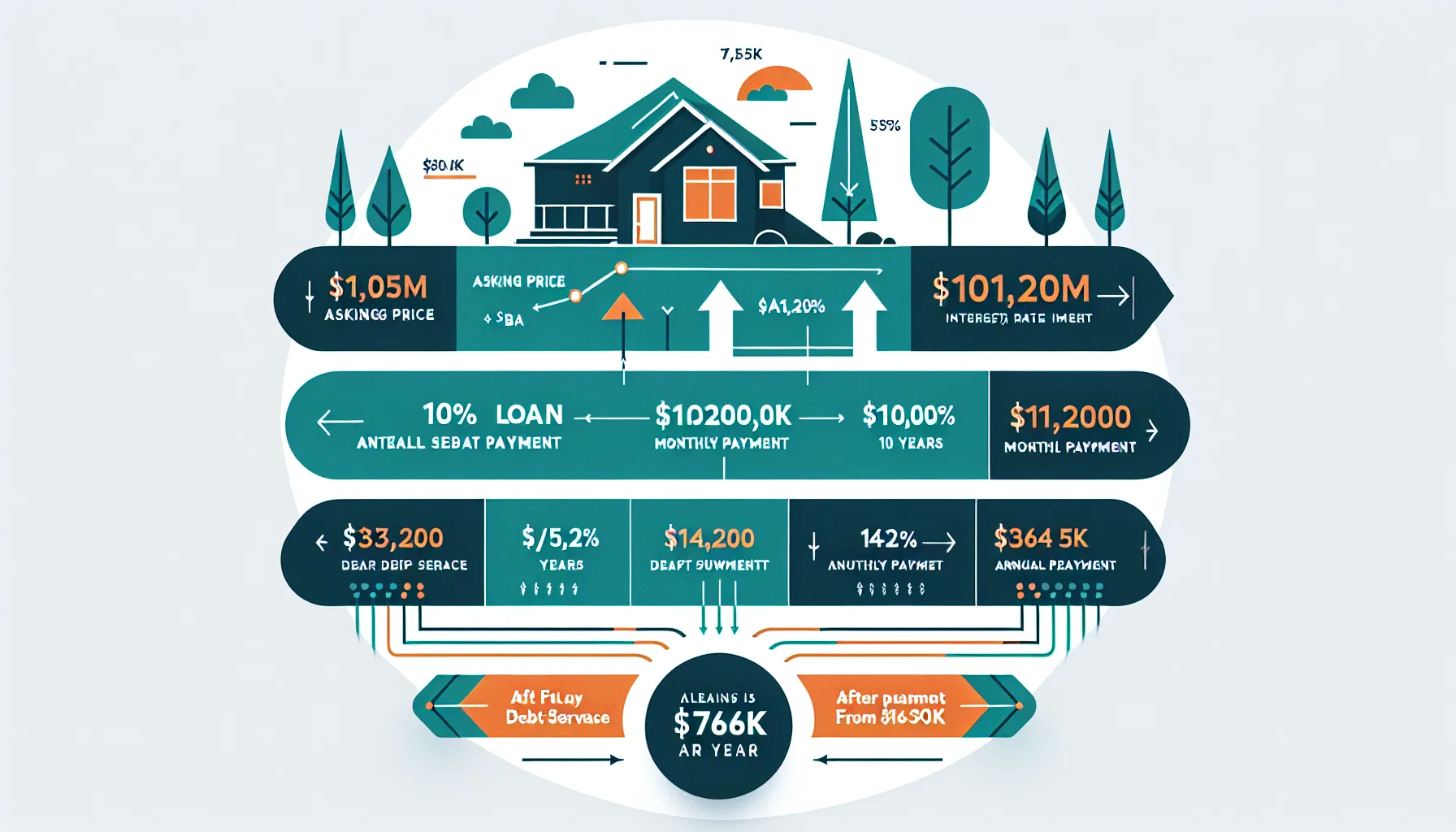
- Asking price: $1.05M (3.5x on $300K SDE)
- Financing: SBA 7(a) loan
- Down payment: 10% ($105,000)
- Loan amount: $945,000
- Term: 10 years
- Interest rate: ~7.5% (variable, based on 2026 prime + spread)
The monthly math
At $945K financed over 10 years at 7.5%, your monthly payment is approximately $11,200.
That's $134,400 per year in debt service. Rain or shine, July or January. That payment doesn't care that your biggest commercial customer just switched to a competitor.
What's left for you
$300,000 SDE minus $134,400 debt service = $165,600 pre-tax.
Now subtract self-employment tax, health insurance, and whatever you were running through SDE that you'll actually need to keep spending. You're looking at roughly $120K–$130K in real take-home in year one.
That's the question: Can you live on $120K–$130K while running a business, managing employees, handling emergencies at midnight, and making that $11,200 payment every single month?
For a lot of people, that's a great deal. You're building equity, you're your own boss, and the debt shrinks every year while (hopefully) the SDE grows.
For some people, that math doesn't work — maybe they have a mortgage that requires more, or a spouse who's going to say "you left a $95K service manager job for this?"
Neither answer is wrong. But you need to run the numbers before you run the emotions.
The Seasonal Stress Test Every HVAC Buyer Must Run
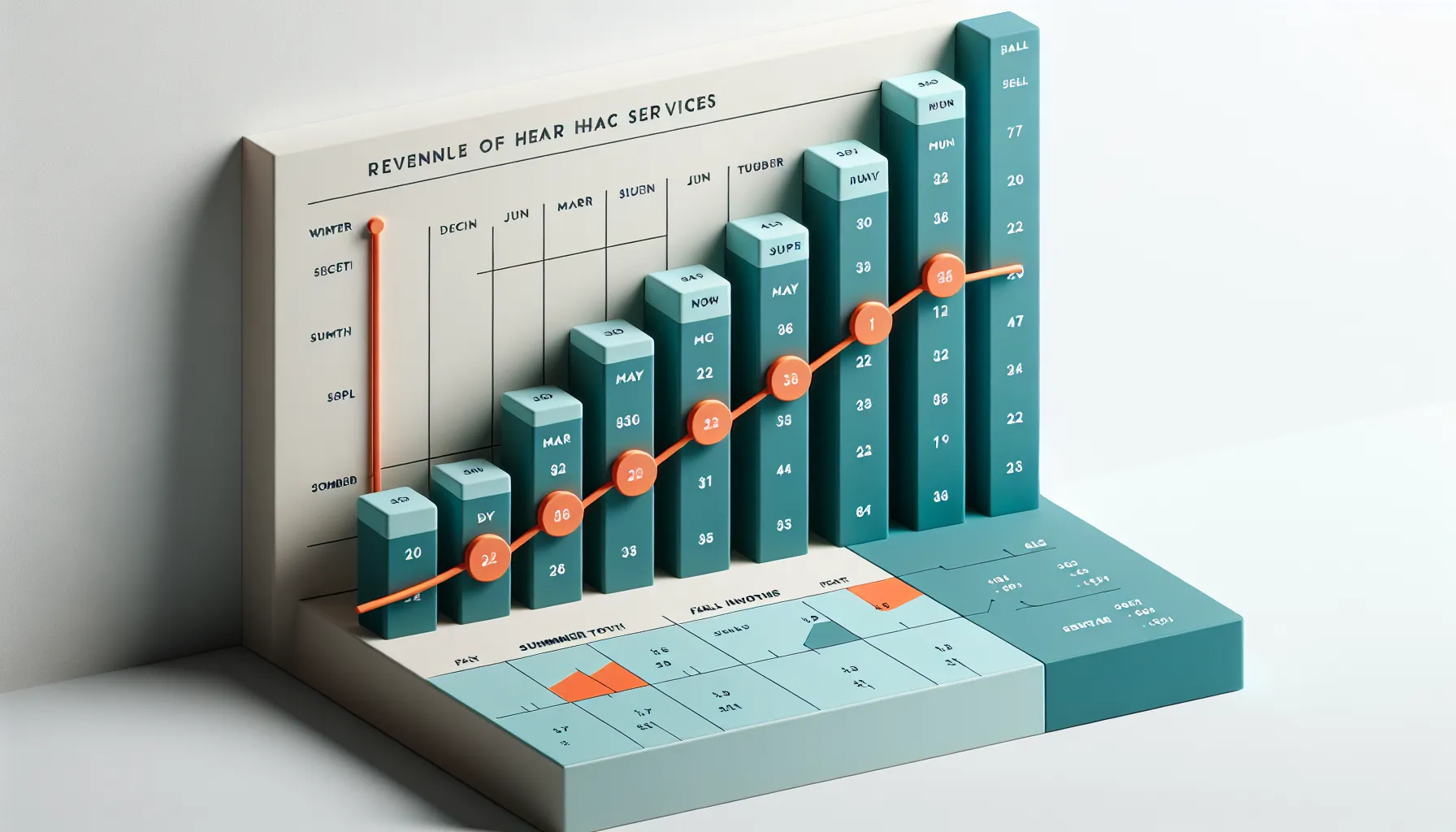
Annual averages lie. A business with $1.2M in annual revenue and $300K SDE sounds healthy. But if $500K of that revenue lands in June, July, and August, your winter months are a different story entirely.
How HVAC revenue actually flows
In cooling-dominated markets (Texas, Florida, Arizona), summer revenue can be 2.5x–3x winter revenue. In heating-dominated markets (Minnesota, Michigan, New England), the pattern flips but is less extreme — maybe 1.5x–2x.
The stress test
Get the seller's monthly revenue for the last three years. Not quarterly — monthly. Then:
- Map monthly revenue against monthly expenses. Include your projected debt service payment in the expense column.
- Find the worst month. Not the average bad month — the single worst month in the last three years.
- Ask: Can I cover all expenses that month with that month's revenue? If no, how much of a shortfall are you looking at?
- Can you cover the shortfall from reserves without panicking? If covering February's gap eats your entire working capital reserve, one bad compressor on a fleet van and you're in trouble.
What the results tell you
- Worst month covers all expenses including debt service: You're in good shape. Proceed.
- Worst month falls short by less than one month's debt service: Manageable, but you need solid reserves. Make sure your working capital buffer is at the high end of the range.
- Worst month falls short by more than one month's debt service: The deal structure needs to change. Either the price comes down, or you negotiate seasonal payment terms (more on that below).
- Multiple consecutive months fall short: This is a warning sign. Either the business isn't as profitable as the SDE suggests, or it needs a revenue diversification strategy that the current owner hasn't executed. You're not buying a business — you're buying a turnaround project. Price accordingly.
Seasonal payment terms
Some SBA lenders will structure seasonal payment schedules — lower payments in slow months, higher payments in peak months. It's not standard, but it's not rare either. Ask your lender. If they look at you like you're speaking Mandarin, find a different lender. This is a normal request in seasonal businesses.
Seller-financed notes are even more flexible. If the seller is carrying any portion of the deal, seasonal terms should be part of the negotiation.
When the Math Doesn't Work (And What to Do About It)
Sometimes the math just doesn't math. That's not a failure — that's the math doing its job.
The debt service coverage ratio (DSCR)
Lenders use this. You should too. DSCR is SDE divided by total annual debt service.
- DSCR of 1.5x or higher: Comfortable. Lenders love this. You'll sleep at night.
- DSCR of 1.25x–1.5x: Tight but workable. You're leaving less room for error, and any dip in revenue is going to stress your cash flow.
- DSCR below 1.25x: The deal is too tight. Either the price is too high, the SDE is too low, or the terms are wrong. Something has to change.
In our example: $300K SDE / $134K debt service = 2.24x DSCR. Healthy. But change the asking price to $1.4M (keeping SDE at $300K), and debt service jumps to ~$165K. DSCR drops to 1.82x. Still okay, but you feel it.
Push to $1.7M? Debt service hits ~$195K. DSCR is 1.54x. You can probably make it work if nothing goes wrong. But something always goes wrong.
Negotiation levers when the math is tight
You don't have to walk away immediately. You have options.
- Lower the price. Obvious, but harder than it sounds. Come with the math. Show them the DSCR and the seasonal stress test. Numbers are more persuasive than "I think it's overpriced."
- Seller financing with seasonal payments. If the seller carries 20–30% of the deal, negotiate lower winter payments and higher summer payments. This alone can make a borderline deal work.
- Longer earn-out. Tie 10–15% of the purchase price to post-sale performance metrics. If the business performs, the seller gets paid. If it doesn't, you're not underwater on an inflated price.
- Equipment excluded from the sale. If the seller owns the building or major equipment personally, exclude those from the business sale and negotiate a separate lease. This lowers the sticker price and potentially lowers your down payment requirement.
- Renegotiate the SDE. Challenge every add-back. That $80K "owner salary" add-back — are you actually going to take $80K less? That $25K in "personal travel" — was it actually personal? Scrutinize the SDE, and the multiple might be fine while the price comes down.
The walk-away number
Know this before you make an offer. Write it on a sticky note. Put it on your bathroom mirror.
Here's a simple framework: If the SDE cannot support your annual debt service plus $100,000 in owner's income, it's not your deal. That $100K floor isn't arbitrary — it's roughly what a good service manager makes in 2026 according to the Bureau of Labor Statistics. If buying a business pays you less than working for someone else and gives you all the risk, the math is telling you something.
Don't argue with the math. Thank the broker, shake the seller's hand, and go find a deal that works.
The Quick-Check Formula
You don't need a spreadsheet for the first pass. Here's a 15-minute checklist you can run on any HVAC listing before you ever call the broker.
- Find the SDE. If the listing shows it, great. If it shows "cash flow" or "owner benefit," treat it as SDE but verify later. If it only shows revenue, assume SDE is 15–25% of revenue as a rough starting point for HVAC companies under $5M.
- Check the multiple against the 2026 market range. Divide asking price by SDE. If the result is 2.75x–4.0x, it's in the ballpark. Below 2.75x, something might be wrong (or it might be a screaming deal — dig deeper). Above 4.0x for a sub-$5M revenue business, the seller is optimistic.
- Calculate monthly debt service. Assume SBA 7(a): 10% down, 10-year term, 7.5% rate. Use any online loan calculator. Plug in 90% of the asking price as the loan amount. Write down the monthly number.
- Subtract annual debt service from SDE. Is the remainder $100K or more? If yes, continue. If no, the deal is probably too tight at the listed price.
- Add CapEx reserves. Estimate fleet replacement costs (count vans over 120K miles x $40K), deferred equipment maintenance ($15K–$30K), and working capital (3 months operating expenses). Is the annual cost of these reserves still leaving you with livable income? If yes, continue.
- Run the seasonal stress test. Ask the broker for monthly revenue data. Find the worst month. Can you cover that month's expenses plus debt service? If not, how deep is the hole, and can your reserves fill it?
- Decision time.
- All six checks pass: Call the broker. Request financials. Proceed to full due diligence.
- Checks 1–4 pass but 5–6 are borderline: The deal might work with negotiation. Worth a conversation.
- Checks 3 or 4 fail: The asking price is too high, the SDE is too low, or both. Make a lower offer backed by math, or move on.
Every listing gets the same seven-step treatment. It'll save you weeks of chasing deals that were never going to work.
Frequently Asked Questions
What's a good SDE multiple for an HVAC business in 2026?
For most individual buyers looking at companies under $5M in revenue, the range is 2.75x–4.0x SDE. The exact number depends on revenue size, revenue mix (maintenance vs. install vs. emergency), customer concentration, and how much of the revenue walks out the door when the current owner does. A business with 60%+ maintenance contract revenue at 3.5x is a better buy than an install-heavy business at 2.75x, even though the second one looks cheaper on paper.
How much cash do I need to buy an HVAC business?
More than you think. SBA 7(a) loans require 10% down on the purchase price. But you also need working capital (2–3 months of operating expenses), closing costs ($15K–$30K), and a reserve for immediate CapEx. For a $1M acquisition, plan on $175K–$250K in total cash at closing. You can fund some through personal savings, 401(k) rollover (ROBS strategy), and seller-held deposits, but you need a realistic cash picture.
Should I pay more for a business with lots of maintenance agreements?
Yes — within reason. Maintenance agreements are the closest thing HVAC has to recurring SaaS-style revenue. They provide predictable cash flow, reduce seasonality, create upsell opportunities (that "maintenance visit" that turns into a $6,000 system replacement), and give you a built-in customer base that renews annually. A business with 1,500 active maintenance agreements at an 85% renewal rate has a revenue floor that a new-install shop simply doesn't. That stability is worth 0.5x–1.0x more in multiple, and lenders agree — SBA underwriters look favorably on recurring revenue.
What if the business has been losing money — is the multiple still relevant?
If the business is genuinely unprofitable — negative SDE after legitimate add-backs — then the standard multiple framework doesn't apply. You're not buying earnings. You're buying assets (trucks, equipment, customer lists, maybe a brand name) and the potential to turn it around. Price should reflect liquidation value of hard assets plus a reasonable premium for the customer base, discounted by the effort required to make it profitable. These deals can be great opportunities, but they're not for first-time buyers unless you really know what you're doing and have capital to fund losses while you fix things.
How do I know if the SDE the seller is claiming is accurate?
You don't — not from a listing. The SDE on a broker listing is the seller's best-case number. Your job in due diligence is to verify every line item. Request three years of tax returns (not internal P&Ls — tax returns, because people lie to brokers but they don't lie to the IRS quite as aggressively). Reconcile the claimed add-backs against actual expenses. If the seller says they added back $60K in "personal vehicle use," ask which vehicles, how many miles, and whether those vehicles are also used for service calls. Hire a CPA with M&A experience to do a Quality of Earnings analysis. It costs $5K–$15K and it's the best money you'll spend in the entire process.
What's the difference between SDE and EBITDA?
SDE includes one owner's full compensation — salary, benefits, perks. EBITDA does not. For owner-operated HVAC businesses, SDE is the standard because the buyer is replacing the owner. For larger businesses where a GM runs daily operations, EBITDA is more appropriate because you'll still pay a manager. If a broker quotes EBITDA on a company where the owner is also the lead estimator and the person answering the phone at 6 a.m., they're inflating the number. Insist on SDE.
The math either works or it doesn't. The beauty of numbers is that they don't care about your feelings, the broker's pitch, or the seller's retirement plans. Run the numbers. Trust the numbers. And if the numbers say walk, walk — because the next deal might be the one where the math says run.